Child's Pose to release and rebalance the hips · Windshield wipers, lying or seated, to internally rotate the hips back to neutral
Time your hold
Three soft ticks and a bell when you're done, so you can close your eyes and stop watching the clock.
How to do it
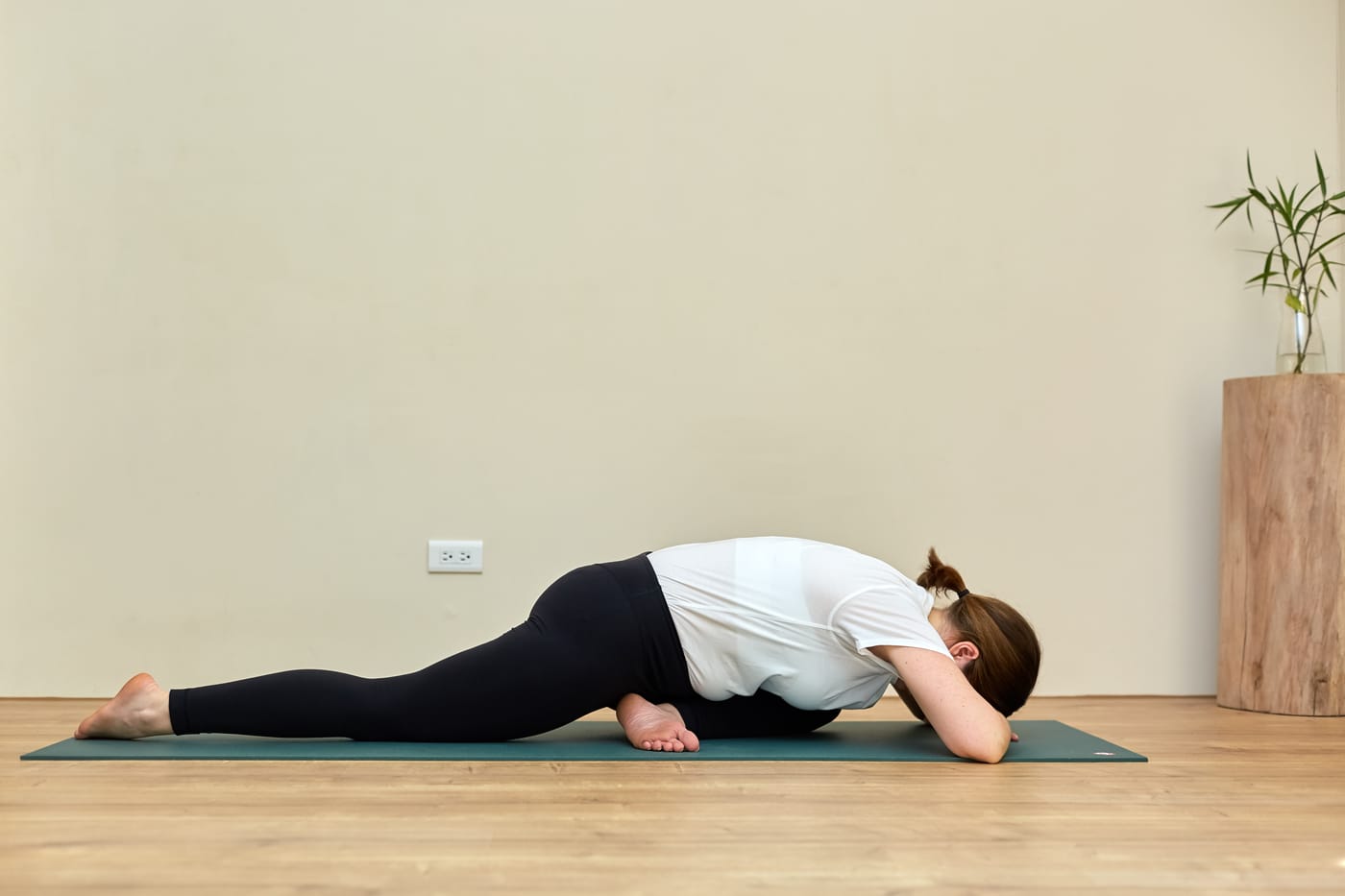
Come as you are. Begin on your hands and knees in a neutral tabletop, or step back from Swan.
Slide your right knee forward toward your right wrist and let the shin angle across the mat. The more diagonal the shin, the gentler it is on the knee — let your hips decide the angle.
Flex the right foot to support the knee, and slide your left leg long behind you, the top of the foot on the floor.
Before you settle, check the front knee. If you feel any pinch, draw the front foot in closer toward your right hip until the knee goes quiet.
On an exhale, walk your hands forward and lower your chest over a few breaths — down onto your forearms, a bolster, a stack of blankets, or the mat.
Let your forehead rest and your whole body grow heavy. Find your edge — about 60–80% of your capacity, a real stretch but never forcing.
Soften completely. Be still, and let the shape do the work. Stay, then repeat on the second side.
Why practice it
A deep hip opener that lets gravity, rather than muscular effort, draw the front hip into strong external rotation.
Lengthens the hip flexors and quadriceps of the long back leg.
Folding forward gives a long, calming release to the lower back.
Stimulates the Liver, Gall Bladder, Kidney, Stomach and Spleen meridian lines.
A grounding, surrendering shape that settles the nervous system — well suited to a slow, quiet practice.
Before you go
Want the follow-along version?
No spam, ever. Unsubscribe any time. I'll only send Yin.
Check your inbox 🌙 your two-hour retreat is on its way.
Take care
Knees first. This pose can drive pressure into the front knee, particularly when the hips are tight. Keep the front foot flexed and, if you feel any pinch, bring the foot in toward the hip until the knee is comfortable. Approach with great caution, or skip, if you have a meniscus injury or any knee instability.
If the hips don't open easily, slip a folded blanket under the seat of the bent-knee side so the pelvis stays level and weight doesn't dump into the knee.
If folding forward compresses the lower back, stay higher on a bolster or forearms rather than reaching for the floor.
Come out slowly. After a long hold the joints feel fragile for a moment — that passes; move gently into your counterpose.
Coming in & out
Into the pose
From Swan — walk the hands forward and lower the chest
From tabletop or Cat (hands and knees)
From Downward-Facing Dog — draw one knee forward between the hands
Out of the pose
Press the floor away with your hands and slowly rise back up through Swan.
Tuck the back toes, press back into Child's Pose to rest.
Common questions
How long do you hold Sleeping Swan in Yin Yoga?
Most people hold Sleeping Swan for 1–5 minutes per side. The long, still hold is what makes it Yin — settle in, soften, and let the shape do the work. Come out a little sooner if you ever need to.
Is Sleeping Swan suitable for beginners?
Sleeping Swan suits you best once you have a little Yin experience. It's still accessible if you ease in slowly, use props where you need them and respect the cautions on this page — never force the shape.
What does Sleeping Swan stretch?
Sleeping Swan mainly works the hips, hip flexors, quadriceps and lower back. A deep hip opener that lets gravity, rather than muscular effort, draw the front hip into strong external rotation.
Do you need props for Sleeping Swan?
You don't have to, but a bolster or folded blanket can make Sleeping Swan more comfortable and help you relax into the hold. Props in Yin aren't a shortcut — they let you stay longer and soften more deeply.
What's the difference between Sleeping Swan and Swan?
Same shape, different depth. Swan keeps the chest lifted and is a little more active — a moderate hip opener with a gentle backbend. Sleeping Swan folds the chest down over the front leg so gravity does the work, giving a deeper, more surrendering hip release. Many people flow from one into the other.
Is Sleeping Swan the same as Pigeon Pose?
The shape is nearly identical to yoga's Pigeon, which is why it's often called Yin Pigeon. The difference is intention: in Sleeping Swan you relax the muscles and let the pose settle into the deep tissues of the hip over a long, still hold, rather than holding it actively.
Is Sleeping Swan safe for your knees?
It can drive pressure into the front knee when the hips are tight. Keep the front foot flexed and, if you feel any pinch, draw the foot in toward your hip until the knee goes quiet. Approach with great caution, or skip it, with a meniscus injury or any knee instability.
Sleeping Swan is one shape among many. When you'd like to put a whole sequence together into one long, slow practice, pop your email in and I'll send you my free two-hour Yin, restorative and Yoga Nidra retreat. Yours to keep.
No spam, ever. Unsubscribe any time. I'll only send Yin.
Check your inbox 🌙 your two-hour retreat is on its way.
Add this to your Home Screen: tap Share, then Add to Home Screen.