A gentle seated or reclined twist to unwind the lower back. · Sphinx or a soft, supported backbend to balance the forward fold.
Time your hold
Three soft ticks and a bell when you're done, so you can close your eyes and stop watching the clock.
How to do it
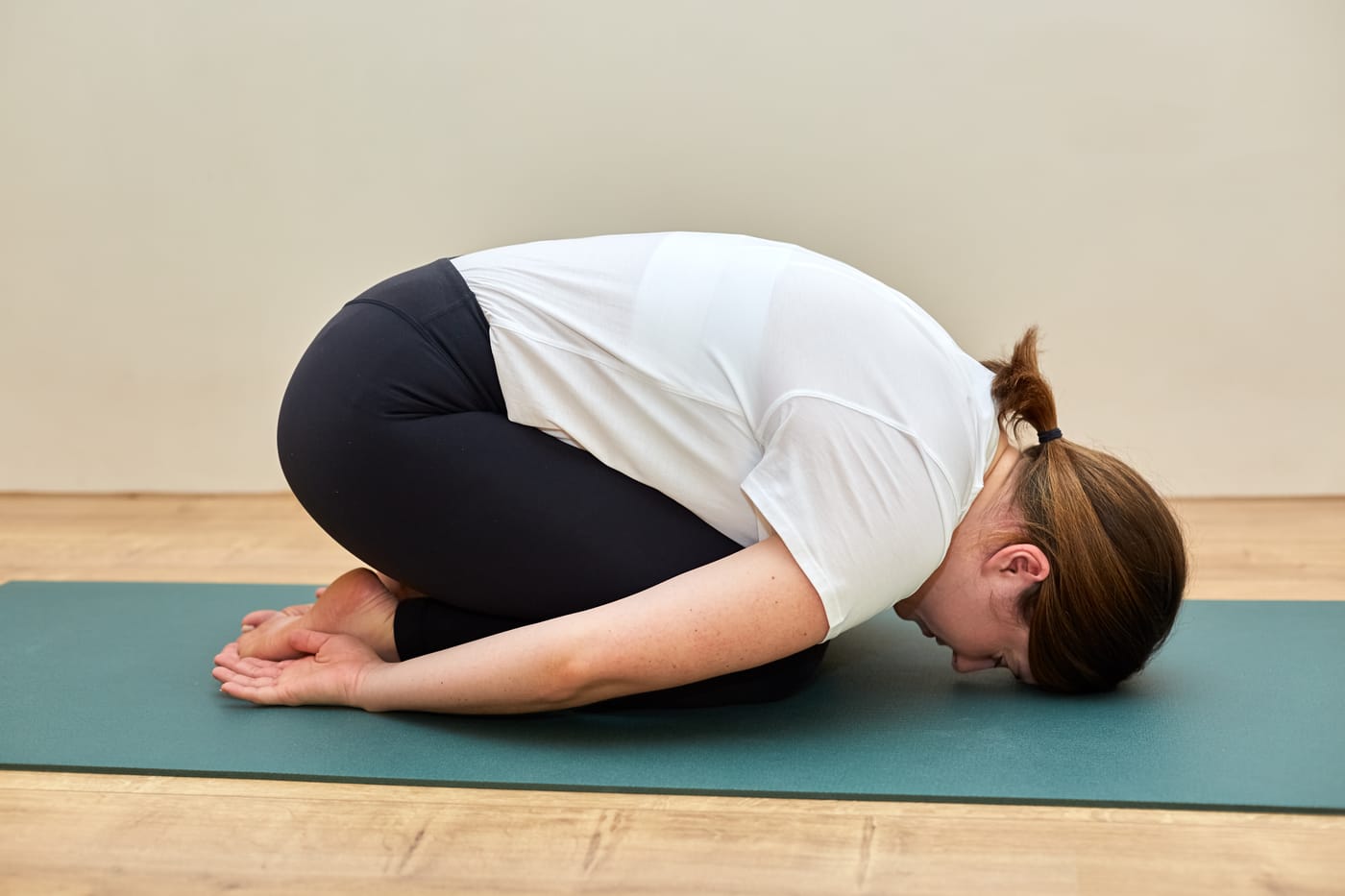
Come to your hands and knees, then sink your hips back toward your heels.
Take your knees as wide as feels good or keep them together — wide gives your belly more room, together feels more like a small parcel.
Let your forehead rest on the mat, a block, or your stacked hands, and reach your arms forward, or let them trail back alongside your body.
Find your edge — about 60–80% of your capacity, a real stretch but never forcing. Let the shape do the work and simply be still.
If your hips float far from your heels, tuck a bolster or rolled blanket between your thighs and calves to rest on.
Why practice it
Gently lengthens the lower back and lets the whole spine settle after backbends or a busy day.
Draws the hips back toward the heels, opening the hips and easing the knees into a soft fold.
A grounding, inward pose that quiets the mind and slows the breath — a place to come home to at any point in your practice.
Encourages steady breathing into the back body, which can feel wonderfully calming.
Before you go
Want the follow-along version?
No spam, ever. Unsubscribe any time. I'll only send Yin.
Check your inbox 🌙 your two-hour retreat is on its way.
Take care
If your knees complain, widen them, add padding behind them, or place a rolled blanket in the crease of the knees to ease the bend.
If you feel a pinch in the front of the hips or lower belly as you fold, take the knees wider — that pinching is compression where the thigh meets the hip, not a stretch to push into.
Coming forward over the belly may be uncomfortable in later pregnancy — take the knees wide, or choose a different resting pose.
If pressure builds in your head or you feel dizzy, turn your head to the side or rest your forehead higher on a block.
Coming in & out
Into the pose
From hands and knees (Table), sit your hips back toward your heels and let your upper body fold down.
From a seated position, come onto your knees and fold forward.
Out of the pose
Come out slowly. Walk your hands back and rise up through the spine to sit on your heels.
Pause and rest for a few breaths before moving on.
Common questions
What does Child's Pose stretch?
Child's Pose gently lengthens the lower back and spine while the hips fold back toward the heels and the knees settle into a soft bend. It's a restful, grounding shape rather than a deep stretch, which is why it makes such a good counterpose after backbends.
How long do you hold Child's Pose in Yin Yoga?
As a Yin pose in its own right, 2–5 minutes is lovely. Used as a quick counterpose between other shapes, even a minute is enough to let the back settle. Stay as long as it feels soothing — there's no need to rush out of it.
Is Child's Pose safe for your knees and in pregnancy?
For sensitive knees, widen them, pad behind them, or tuck a rolled blanket into the crease to ease the bend, and cushion the ankle-tops if they feel tender. Folding over the belly can be uncomfortable in later pregnancy, so take the knees wide or choose a different resting pose.
What's the difference between Child's Pose and Corpse Pose?
Both are resting poses, but they hold the body differently. Child's Pose is a kneeling forward fold that gently opens the lower back and hips and feels grounding and inward. Corpse is lying flat on your back in complete neutrality — the final rest at the very end of a practice.
Child's Pose is one shape among many. When you'd like to put a whole sequence together into one long, slow practice, pop your email in and I'll send you my free two-hour Yin, restorative and Yoga Nidra retreat. Yours to keep.
No spam, ever. Unsubscribe any time. I'll only send Yin.
Check your inbox 🌙 your two-hour retreat is on its way.
Add this to your Home Screen: tap Share, then Add to Home Screen.