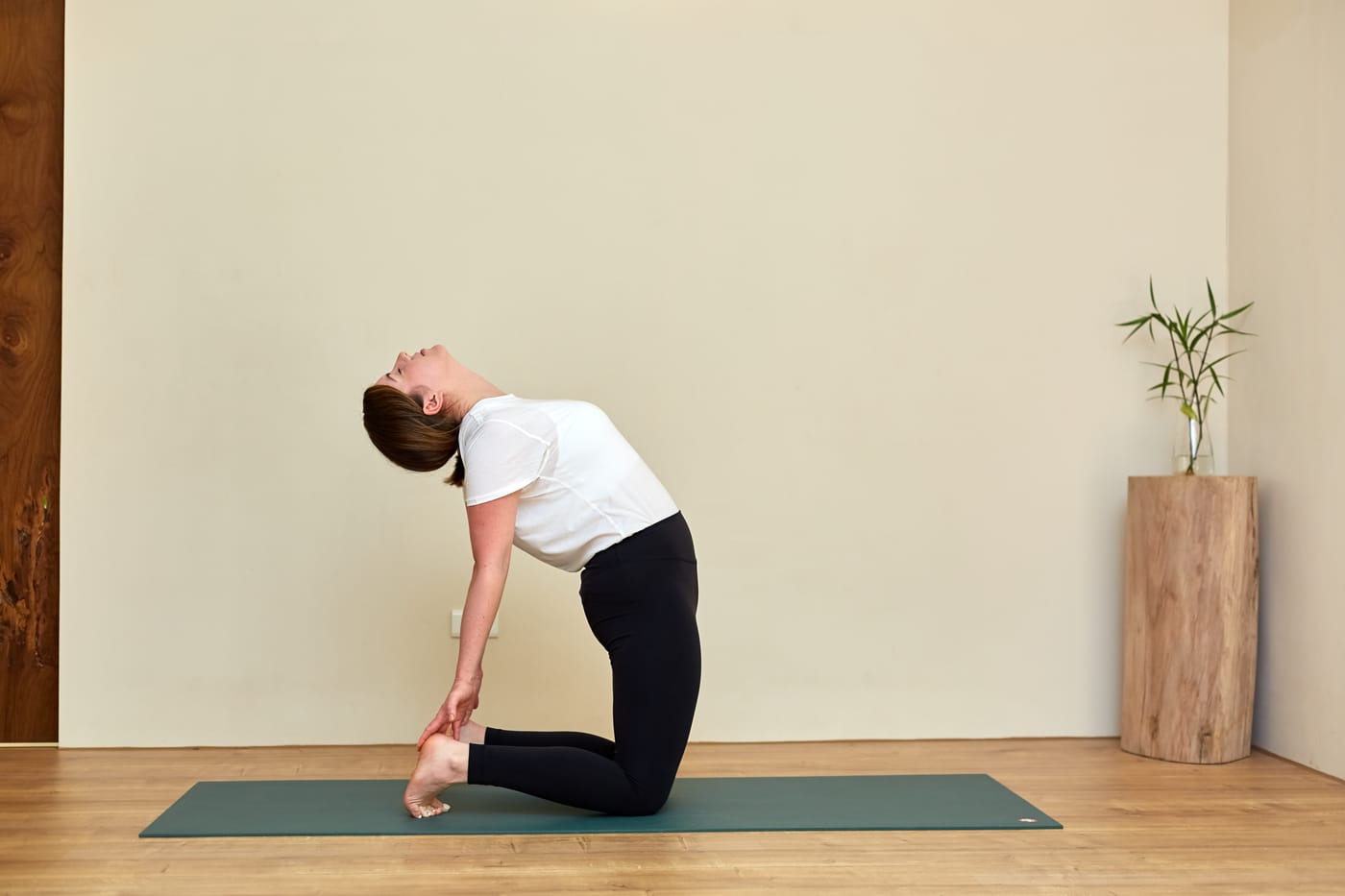
Child's Pose, to release the lower back · A quiet seated rest with a soft, neutral spine before the next shape
Time your hold
Three soft ticks and a bell when you're done, so you can close your eyes and stop watching the clock.
How to do it
Kneel with your knees hip-width apart, shins and the tops of the feet on the floor. Pad the knees with a folded blanket if they feel tender.
Bring your hands to your lower back, fingers pointing down, and lift up out of the waist to make length before you lean back.
Press the hips gently forward over the knees and begin to arch back, leading with the chest rather than dropping the head.
For the gentler option, keep your hands on your lower back and stay here. For more, reach the hands back toward your heels one at a time.
Find your edge — about 60–80%, a real opening across the front but never straining the neck or lower back. A broad stretch across the front of the body is soft-tissue tension and safe to explore; a pinching or bone-on-bone feeling deep in the lower back is compression, a hard stop — ease off it. Let the head follow the spine only if the throat is comfortable.
This one is more yang, so hold it briefly. Breathe steadily and come out well before you feel any strain.
Why practice it
A generous front-body opener that stretches the chest, shoulders, belly, throat and the front of the thighs all at once.
Arches and tonifies the whole spine, countering the forward-rounded posture that daily life encourages.
Works the Stomach and Spleen lines down the front of the body and the Kidney and Urinary Bladder lines along the spine.
More active than most yin shapes — a little muscular effort holds you here, so it is held shorter and can feel bright and energising.
Before you go
Want the follow-along version?
No spam, ever. Unsubscribe any time. I'll only send Yin.
Check your inbox 🌙 your two-hour retreat is on its way.
Take care
This is the most active pose in this set and the one most likely to strain the lower back — lift and lengthen up out of the waist before you lean back, and spread the arch through the whole spine rather than collapsing into one lumbar crunch. How far you can backbend depends on the shape of your own spine, so let your bones set the limit.
Protect the neck: let the head drop back only if it feels easy, otherwise keep the chin gently toward the chest.
Approach cautiously with lower-back, neck or knee injuries, and with high or low blood pressure. Come out at once if you feel dizzy or lightheaded.
Pad tender knees, and skip the pose if kneeling with the tops of the feet down is painful.
Coming in & out
Into the pose
From kneeling upright, hands to the lower back, then arch back.
Out of the pose
Come out slowly: bring the hands back to your lower back, lead with the chest to lift up, and lower down. Rest in Child's Pose.
Common questions
What does Camel Pose stretch?
Camel is a front-body opener: it stretches the chest, shoulders, belly, hip flexors and the front of the thighs while arching the whole spine. Because it works the front line, many people find their chest and shoulders feel more open afterwards — a welcome counter to a day spent hunched forward.
How long do you hold Camel in Yin Yoga?
Hold Camel for about 30 seconds to 2 minutes — shorter than most Yin poses. It's a more active, yang-like shape that asks for some leg and back effort, so a briefer hold keeps it safe. Come out well before you feel any strain, and rest in Child's Pose afterwards.
Is Camel Pose safe for your lower back?
It can be, if you keep length in the spine and spread the backbend evenly rather than folding sharply at the lumbar. A broad opening across the front of the body is soft-tissue tension and fine to explore slowly; a pinching, bone-on-bone sensation in the lower back is compression — a hard stop to ease away from. Approach cautiously with any back or neck injury and use the hands-on-lower-back version.
What's the difference between Camel and Saddle?
Both are Yin backbends that open the front body, but Camel is kneeling and more active — you lift up and arch back, leading with the chest. Saddle is more passive: you recline back over or between the feet and let gravity do the work, with more emphasis on the front of the thighs and the ankles.
Camel is one shape among many. When you'd like to put a whole sequence together into one long, slow practice, pop your email in and I'll send you my free two-hour Yin, restorative and Yoga Nidra retreat. Yours to keep.
No spam, ever. Unsubscribe any time. I'll only send Yin.
Check your inbox 🌙 your two-hour retreat is on its way.
Add this to your Home Screen: tap Share, then Add to Home Screen.