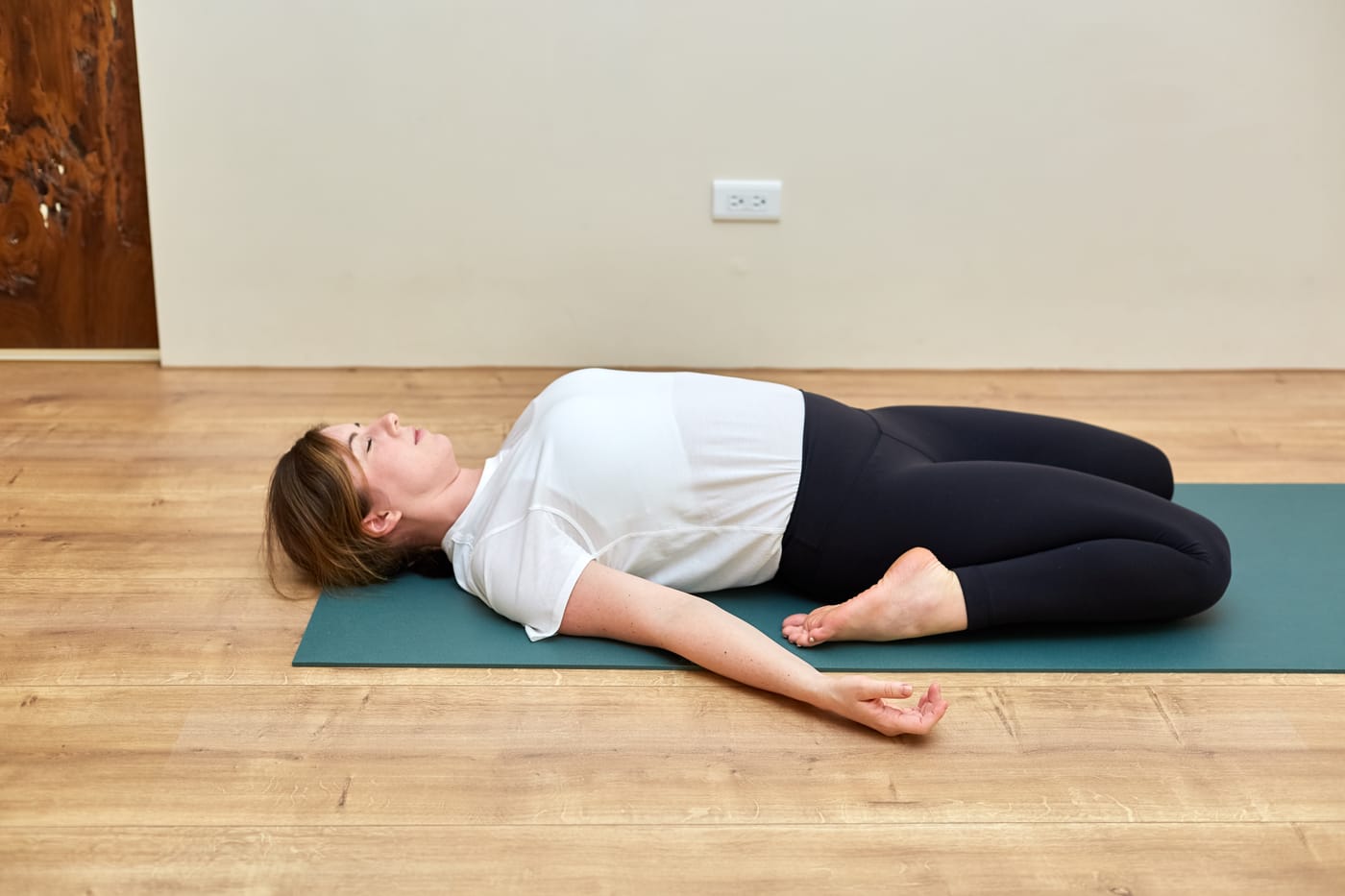
front of thighship flexorslower backsacrumspineknees
Meridians
stomachspleenkidneyurinary bladder
Props
bolsterblockblanket
Counterpose
Sitting with the legs straight out in front, gently bouncing the knees, to flush the quads · A slow forward fold such as Caterpillar to counter the backbend
Time your hold
Three soft ticks and a bell when you're done, so you can close your eyes and stop watching the clock.
How to do it
Begin kneeling with your feet alongside your hips, not underneath you, so you are sitting between your heels. If sitting down is already too much for the knees or ankles, this is your pose — stay upright.
Only if that is comfortable, begin to lean back onto your hands, then your forearms, letting the front of the thighs stretch.
For the gentler option, rest back onto a bolster or a stack of blocks that meets your spine — let the prop hold you rather than reaching for the floor.
For the deepest option, and only if the knees and back are happy, lower all the way down so the back rests on the floor. Never force toward it.
Find your edge — about 60–80%, a strong stretch through the thighs but never sharp pain in the knees. Back off the moment the knees protest.
One knee at a time can be lifted to ease out, or keep the legs closer if wide is too much. Let the shape do the work and be still.
Why practice it
A strong opener for the front of the thighs and the hip flexors — the muscles that shorten with sitting, cycling and running.
Compresses and stimulates the sacral-lumbar arch, restoring the natural curve of the lower back.
Works the Stomach and Spleen lines down the front of the legs and the Kidney and Urinary Bladder lines along the spine.
A rich, full front-body stretch — and one to enter with patience, because it asks a great deal of the knees and lower back.
Before you go
Want the follow-along version?
No spam, ever. Unsubscribe any time. I'll only send Yin.
Check your inbox 🌙 your two-hour retreat is on its way.
Take care
This is the most cautious pose in the set. Any sharp or pinching pain in the knees means come out at once — the knees are vulnerable in this deep bend and should never be forced.
Protect the lower back: as you lean back the lumbar spine compresses, so use a bolster or blocks to shorten the range, and ease off at any sharp lower-back sensation.
Approach cautiously — or skip entirely — with any knee, ankle or lower-back injury, or with tight quadriceps that pull hard on the knees.
Never rush in or out. Come out slowly; sudden movement here is where knees and backs are strained.
Coming in & out
Into the pose
From kneeling between the heels, lean back onto the hands, then the forearms, then lower as far as is comfortable.
Out of the pose
Come out slowly and mindfully: press back up onto the forearms and hands, then straighten the legs out in front of you one at a time to release the knees.
Common questions
How long do you hold Saddle in Yin Yoga?
Most people hold Saddle for 1–5 minutes. The long, still hold is what makes it Yin — settle in, soften, and let the shape do the work. Come out a little sooner if you ever need to.
Is Saddle suitable for beginners?
Saddle is one of the deeper Yin poses, so build up to it patiently. Ease in slowly, use props to meet you where you are, and back off the moment anything feels sharp. When in doubt, choose a gentler variation.
What does Saddle stretch?
Saddle mainly works the front of thighs, hip flexors, lower back, sacrum, spine and knees. A strong opener for the front of the thighs and the hip flexors — the muscles that shorten with sitting, cycling and running.
Do you need props for Saddle?
You don't have to, but a bolster, block or blanket can make Saddle more comfortable and help you relax into the hold. Props in Yin aren't a shortcut — they let you stay longer and soften more deeply.
What's the difference between Saddle and Half Saddle?
Half Saddle keeps one leg straight out in front while the other folds back, so it's gentler on the knees and lower back — a good stepping stone. Full Saddle folds both legs back at once for a deeper opening through the front of the thighs and the sacral-lumbar curve.
Is Saddle safe for your knees and lower back?
Ease in slowly. The stretch across the front of the thighs is soft-tissue tension you can gently explore; the sensation deep in the lower back is compression — a firmer limit, so never force it. Use a bolster or blocks to shorten the range, come out at any sharp knee or back pain, and choose Sphinx if Saddle is too much.
Saddle is one shape among many. When you'd like to put a whole sequence together into one long, slow practice, pop your email in and I'll send you my free two-hour Yin, restorative and Yoga Nidra retreat. Yours to keep.
No spam, ever. Unsubscribe any time. I'll only send Yin.
Check your inbox 🌙 your two-hour retreat is on its way.
Add this to your Home Screen: tap Share, then Add to Home Screen.