
Yin Yoga · Nervous-system · Stress · Sleep
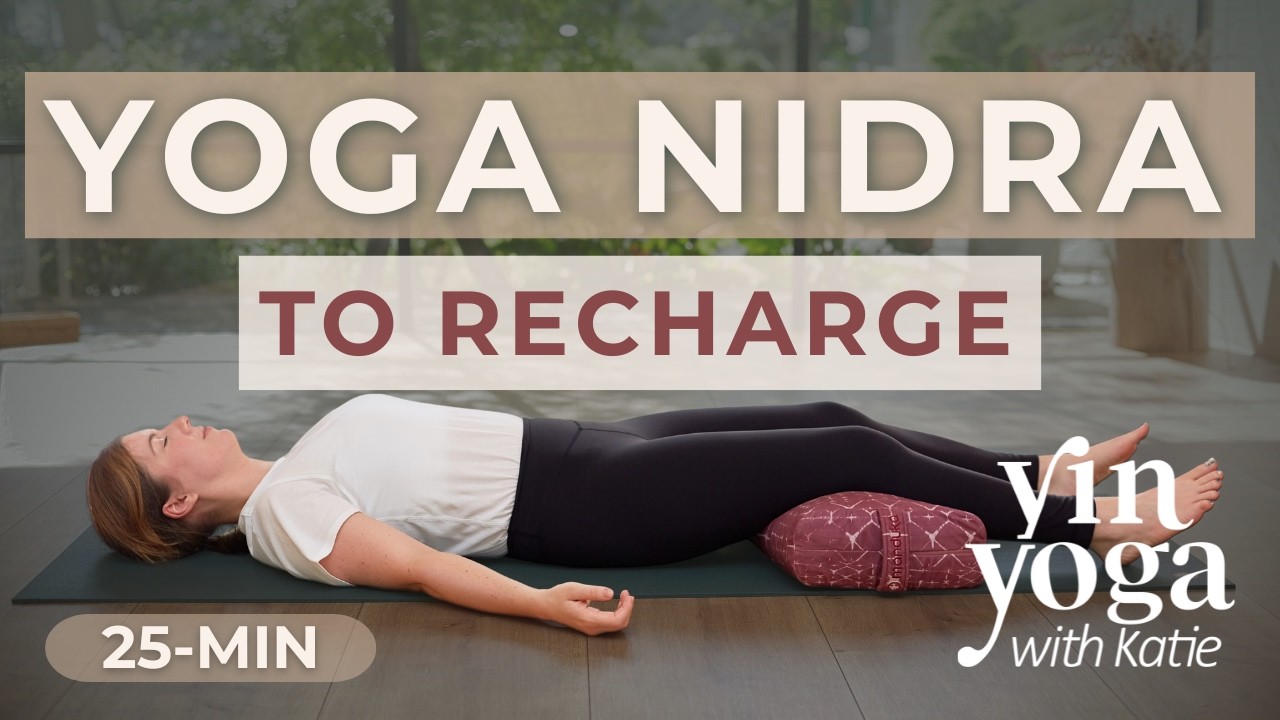
Nothing to do but lie there and notice
Watch the full class on YouTubeBefore you go
No spam, ever. Unsubscribe any time. I'll only send Yin.
Check your inbox 🌙 your two-hour retreat is on its way.
No poses in this one. You lie down, get warm, and listen.
Katie sets the frame before anything starts, and it’s the part worth keeping: nothing is supposed to happen in Yoga Nidra. Nothing is good or bad, nothing is right or wrong. Your job is only to welcome whatever turns up, recognise it for what it is — a thought, a feeling, a sound — and witness it.
It opens with broad awareness: something outside you, then something inside you, then both at once. Then a sankalpa, a short intention in the present tense, which you’ll be asked for again near the end.
The long middle is the rotation of consciousness — attention moved piece by piece through the body. Mouth, eyes, forehead, face, the back of the head. One arm, then the hand, then each finger, then the other. Chest, belly, back, pelvis. Each leg, each foot, each toe.
Then the opposites: feeling very large, then very small, then somehow both. It isn’t supposed to add up.
Your sankalpa once more, broad awareness again, and a count back from five.
Get properly comfortable first. Blankets, pillows, an eye pillow if you have one. Twenty-five minutes is a long time to be slightly cold.
Tap a time to jump to that moment on YouTube · tap a pose to open its page.
A gift from me
✦ A members-only class — free for you
Enjoyed this class? I'll send you my free two-hour Yin, restorative and Yoga Nidra retreat — two slow hours to properly switch off, yours to keep. Just pop your email in.
No spam, ever. Unsubscribe any time. I'll only send Yin.
Check your inbox 🌙 your two-hour retreat is on its way.
A guided practice done lying completely still, where a voice moves your attention around the body and you simply notice what's there. Katie's framing at the start is the useful one: nothing is supposed to happen, nothing is good or bad, and your job is only to welcome whatever arises, recognise it, and witness it.
That's fine, and she says so. The invitation is to keep listening if you can, but drifting off isn't failing at it.
A short intention you set near the start and repeat near the end — a positive statement, phrased in the present, about something already under way. Katie offers openings you can finish yourself: I am on the road to…, I have everything inside of me that I need to…
It's the practice of opposites. You adopt the feeling of your body being very large, then very small, then both at once. She tells you not to try to make it make sense, which is the right instruction — it isn't meant to be solved.
Roughly. There are no chapter markers on the video because there are no poses to mark, so the stages listed here are approximate — close enough to find your way back to a part you want, not to the second.
Whatever keeps you warm and comfortable enough to stay still for twenty-five minutes. Blankets, pillows and an eye pillow are all invited, and a bed is perfectly reasonable.
Or browse every class in the library.
