

the journal · for runners
Sore Legs After Running: What Actually Helps the Next Day
the honest version, including what doesn't work
You know before you open your eyes. You shift a leg under the duvet and something in your quads objects, and you remember yesterday’s run and what it is going to cost you to get down the stairs.
Here is what is actually happening, what the evidence says about fixing it, and the honest answer about where a slow practice fits — which is not where most yoga-for-runners articles will tell you.
What soreness after running actually is
It is not lactic acid. That one has been repeated for forty years and it is simply wrong — lactate clears from your blood within about an hour of finishing. If your legs still hurt on Tuesday, lactate has been gone since Sunday lunchtime.
What you have is delayed-onset muscle soreness, and the clue is in the delay. Running is full of eccentric work: your quads and calves lengthening under load, braking you on every footfall, thousands of times. That braking causes a small amount of disruption in the muscle, and over the following day your body mounts an inflammatory response to repair it. The ache is the repair, not the damage.
It shows up 12 to 24 hours later, peaks somewhere around 24 to 48 hours, and fades after that. And it is worst after something unfamiliar — your first long run in months, a hilly race, a downhill section, a faster session than usual. Do the same run again in three weeks and it will barely register. That is your legs adapting, which is the entire point.
What doesn’t help (the part nobody wants to write)
Stretching does not fix it. This is well studied and the answer is fairly consistent: stretching before or after exercise makes little to no meaningful difference to how sore you are or how long it lasts. Not zero, but nothing like enough to hang a promise on.
I teach Yin. It would be easy to leave that out, and you would be more likely to book something. But the honest version buys more than the useful-sounding one, and you would work it out for yourself by Wednesday anyway.
Nor does going harder at it. A deep, aggressive stretch into a muscle that is already inflamed is not a shortcut. If anything it adds to the load while the tissue is trying to repair.
What does help
- Easy movement. A walk, a swim, a very easy jog, or a slow floor practice. Nearly every runner finds the first ten minutes miserable and the next hour a great deal better. Blood flow to the area is doing the work.
- Sleep. The single most effective recovery tool there is, and the least glamorous.
- Food, and enough of it. Repair needs protein and it needs calories. Under-eating after a long run is a slow way to stay sore.
- Time. Two to three days, most of the time. Nothing shortens that dramatically, whatever the recovery-gadget market says.
- Elevation and warmth. Won’t speed the repair, but makes the waiting far more comfortable.
So where does Yin come in?
Not as a cure. As the thing that makes the day liveable, and stops the soreness turning into a week of moving badly.
When you are sore you brace. You take the stairs sideways, you sit down more carefully, you hold your hips and low back tight all day without noticing. By evening you are stiff in places you never ran with. A slow practice interrupts that — it gets blood through the sore tissue, it lets the bracing go, and lying still and breathing for twenty minutes does something for a nervous system that has been on alert since mile eighteen.
There is also the timing, which most advice gets backwards. The day after is a different practice from straight after a run. Straight after, you are warm and you can hold a lunge. The next morning, your legs do not want to kneel, and nothing deep is welcome. So the shapes have to change.
The shapes for a sore morning
All of these are done lying down. Nothing kneels, nothing takes weight through a sore quad, and nothing goes anywhere near your edge.
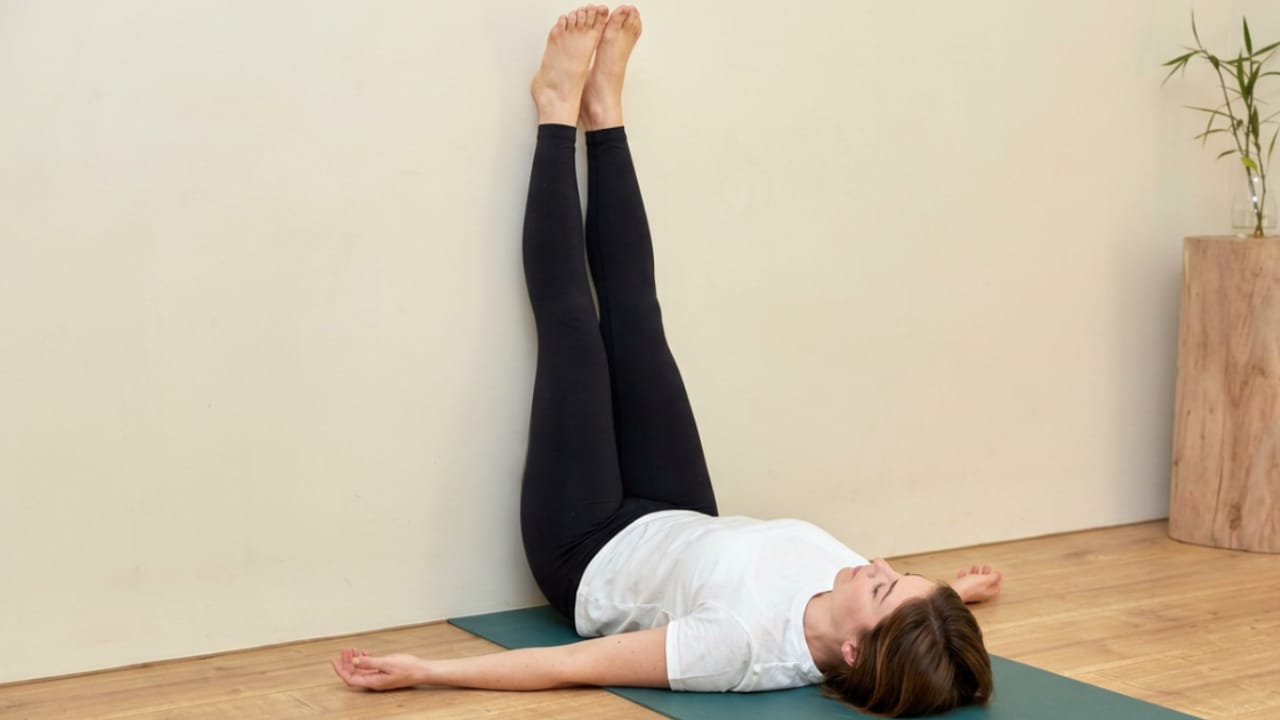
1. Legs Up the Wall — 5 minutes. Shuffle your hips close to a wall and swing your legs up it. That is the whole thing. Heavy, aching legs feel dramatically better within about two minutes, and it asks nothing of you at all. If you only do one thing on this list, do this one.
2. Reclined Swan — 2 to 3 minutes each side. On your back, ankle crossed over the opposite thigh, and draw that thigh gently toward you. It reaches the glutes and outer hip — the same tissue as a kneeling Swan, without kneeling on legs that would rather not.
3. Reclined Twist — 2 to 3 minutes each side. Knees drop to one side, shoulders stay heavy. Running is relentlessly forward and this is the rotation you never otherwise get. It also reaches the low back, which has been quietly bracing since you got out of bed.
4. Banana — 90 seconds each side. Walk your feet and shoulders to one side into a long crescent. The side body gets missed by essentially every runner stretch routine, and it is part of why the outer hip feels tight.
5. Corpse — 2 minutes or as long as you like. Do nothing. This is not the filler at the end; for a sore body it may be the most useful two minutes of the lot.
If you have five minutes rather than twenty
Legs up the wall. That is it. It is the highest return per minute of anything in this article.
The one that gets you to Wednesday
None of this makes soreness vanish, and I would not trust anyone who says otherwise. What it does is get you through the day moving like yourself, and get blood into legs that are busy repairing.
If soreness like this is a regular event rather than a race-week one, the fix usually is not what you do the morning after — it is what you do on the other six days. Tightness that never gets undone is what turns an ordinary hard session into three days of hobbling.
For the other six days, I have gathered the classes runners get the most out of on one page: Yin Yoga for Runners. Legs, glutes, hip flexors, tired feet — ten minutes to seventy, in the order I would hand them to you.
While you're here
Want the follow-along class?
A filmed class with Katie: follow-along video, hold timer and written cues. Free, yours to keep.
No spam, ever. Unsubscribe any time. I'll only send Yin.
Check your inbox 🌙 your Post-Run Reset is on its way.
Common questions
Why are my legs sore two days after running?
That is delayed-onset muscle soreness, and the delay is the giveaway. It is not lactic acid — that clears within an hour of finishing. It is the small amount of muscle damage that comes from the braking part of running, plus the inflammation that follows while the tissue repairs itself. It typically arrives 12 to 24 hours afterwards and peaks around the 24 to 48 hour mark.
Does stretching help sore muscles after running?
Not in the way most people hope. Stretching has not been shown to meaningfully prevent or reduce delayed-onset soreness, and anything promising otherwise is overselling. What gentle movement does do is stop you stiffening up around the soreness, get blood moving through the area, and settle a nervous system that has been braced since the run. Those are real, and they are worth twenty minutes.
Should I rest completely or keep moving?
Keep moving, gently. Complete stillness tends to leave you stiffer, and most runners find that an easy walk, a swim or a slow practice makes the day noticeably better. What you want to avoid is another hard session on top.
How do I get rid of sore legs fast?
Honestly, you mostly wait. Sleep, food and time do the bulk of the work, and nothing shortens the process dramatically. Gentle movement, warmth and elevation make the waiting a lot more comfortable, which is not nothing when you have a day to get through.
When is soreness a sign of injury?
Soreness is dull, spread across a muscle, symmetrical, and easing by day three. Be suspicious of pain that is sharp, in one specific spot, on one side only, worse when you run rather than better, or still there after four or five days. That is a physio's question, not a stretching one.
Does soreness mean it was a good run?
No. It mostly means the run was unfamiliar — longer, hillier, faster or on different ground than your legs are used to. Well-trained runners get less sore doing the same session, and that is progress, not a missed opportunity.
From the mat
Ready to actually practice?
✦ A filmed class with Katie — free for you
Reading about it is one thing — feeling it is another. Pop your email in and I'll send you my free 15-Minute Post-Run Reset: a properly filmed class you follow along with me after your run, with a hold timer and written cues underneath. Yours to keep.
No spam, ever. Unsubscribe any time. I'll only send Yin.
Check your inbox 🌙 your Post-Run Reset is on its way.