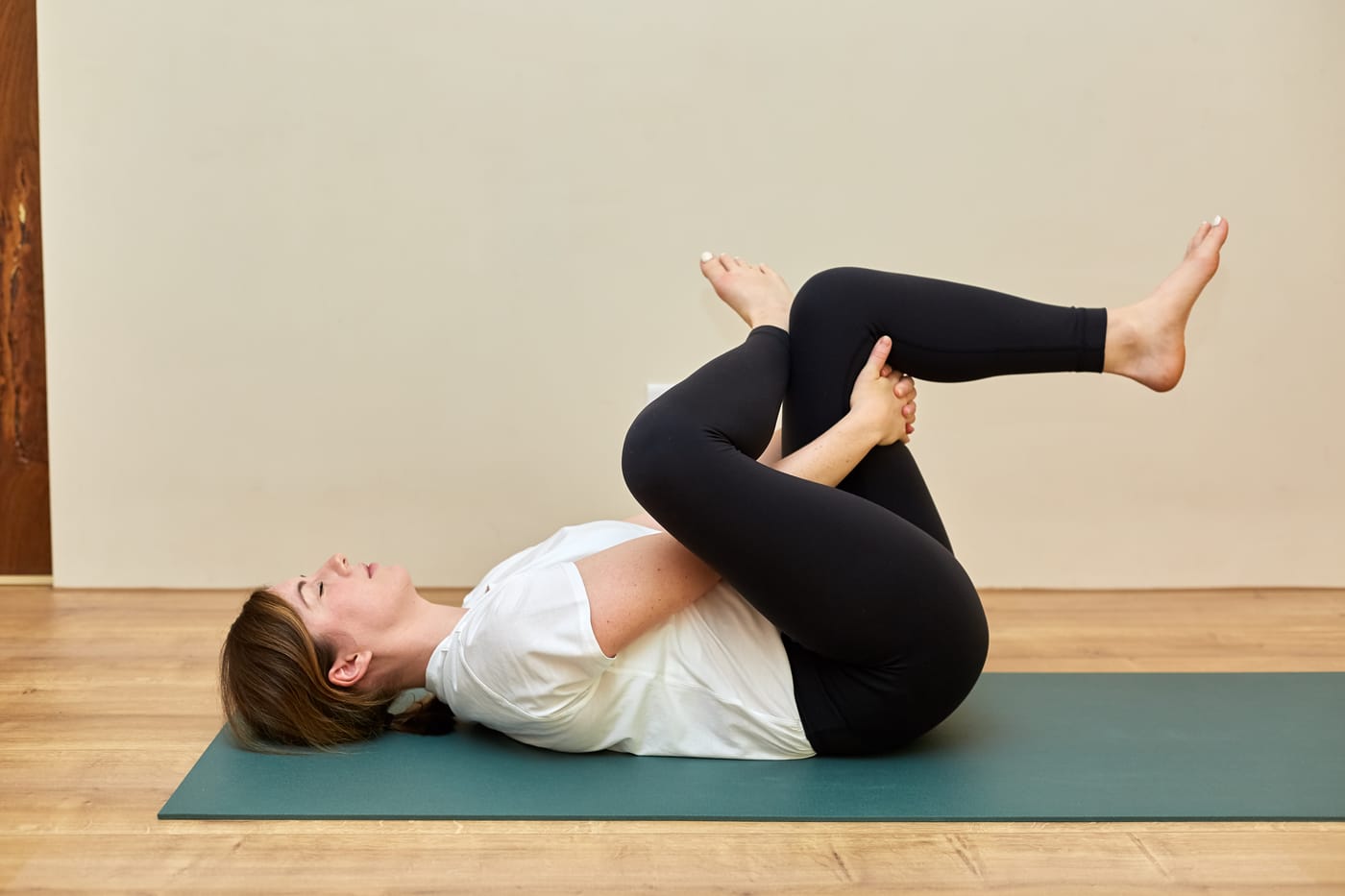
Knees hugged to the chest to settle the lower back · A reclined twist to release across the hips and spine
Time your hold
Three soft ticks and a bell when you're done, so you can close your eyes and stop watching the clock.
How to do it
Lie on your back with both knees bent and the feet flat on the floor.
Cross your right ankle over your left thigh, just above the knee, and gently flex the right foot to support the ankle and knee.
Let the right knee open away from you, so the shape makes a figure four.
Reach your right hand through the gap between your thighs and your left hand around the outside of the left leg. Clasp your hands behind the left thigh — or hold the shin if that's within reach.
Draw the left thigh toward your chest until you find your edge — about 60–80% of your capacity, a real stretch through the right outer hip but never forcing.
Let your head, shoulders and lower back stay heavy on the floor. If reaching the thigh lifts the head, loop a strap around it instead, or rest the lifted foot against a wall.
Be still, soften, and let the shape do the work. Stay, then swap sides.
Why practice it
An accessible hip opener that draws the front hip into external rotation while you lie safely on your back.
Releases the glutes and the outer hip, easing tension that often gathers there from sitting.
Because the floor supports you, it's far kinder to the knees than the kneeling Swan poses.
Stimulates the Gall Bladder, Liver, Kidney, Stomach and Spleen meridian lines.
A calming, low-effort shape — lovely near the end of a practice or any time the front-of-body poses feel too much for the knees.
Before you go
Want the follow-along version?
No spam, ever. Unsubscribe any time. I'll only send Yin.
Check your inbox 🌙 your two-hour retreat is on its way.
Take care
Mind the front knee. Keep the crossed foot flexed to support the knee, and back off if you feel any pinch in the joint rather than a stretch in the hip. Take care, or skip, with a meniscus or knee injury.
If your head and shoulders lift off the floor when you draw the leg in, use a strap around the thigh or press the lifted foot into a wall so the neck and back can stay soft.
For lower-back or sacroiliac sensitivity, keep the draw-in gentle and shallow — the stretch belongs in the hip, not the back.
Come out slowly and hug the knees in before moving on.
Coming in & out
Into the pose
From lying on your back with the knees bent — cross one ankle over the opposite thigh
From a reclined position after Happy Baby or a reclined twist
Out of the pose
Release the hands, uncross the ankle and set both feet back on the floor.
Hug both knees into the chest for a breath or two to neutralise the hips.
Common questions
What does Reclined Swan stretch?
Reclined Swan draws the front hip into external rotation, so most people feel it in the glutes and the outer hip — the area that often tightens from sitting. Because you lie on your back, the lower back and knees stay well supported.
How long do you hold Reclined Swan in Yin Yoga?
Most people hold Reclined Swan for 2–5 minutes per side. The long, still hold is what makes it Yin — settle in, soften, and let the shape do the work. Come out a little sooner if you ever need to.
What's the difference between Reclined Swan and Sleeping Swan?
Both open the hip in external rotation, but Reclined Swan does it lying on your back with the floor taking the weight, while Sleeping Swan is done face-forward over a bent front leg and asks much more of the knee. Reclined Swan is the kinder choice if kneeling hip openers bother your knees.
Is Reclined Swan safe for the knees?
It's usually gentler on the knees than the kneeling Swan poses because the joint isn't bearing weight. Keep the crossed foot flexed to support the ankle and knee, and back off if you feel any pinch in the joint rather than a stretch in the hip. Take care, or skip it, with a meniscus or knee injury.
Reclined Swan is one shape among many. When you'd like to put a whole sequence together into one long, slow practice, pop your email in and I'll send you my free two-hour Yin, restorative and Yoga Nidra retreat. Yours to keep.
No spam, ever. Unsubscribe any time. I'll only send Yin.
Check your inbox 🌙 your two-hour retreat is on its way.
Add this to your Home Screen: tap Share, then Add to Home Screen.