

the journal · beginners
Yin Yoga for Beginners: What It Is & How to Start Tonight
start where you are
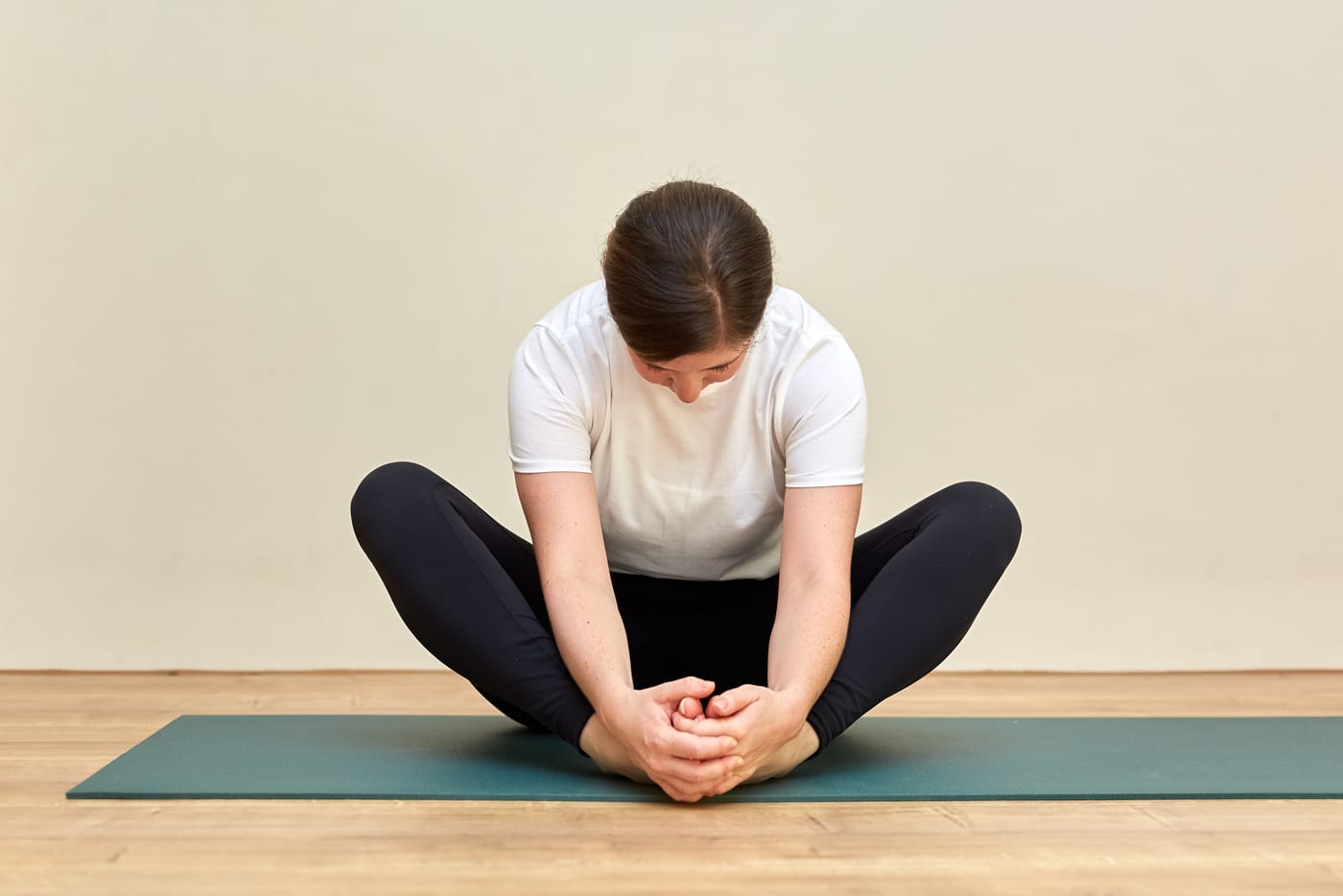
Yin Yoga is a slow, quiet style of yoga where you settle into gentle, mostly floor-based shapes and hold each one for a few minutes, letting gravity — not muscular effort — do the work. It’s one of the kindest ways to begin a practice: there’s no flow to memorise, nothing to keep up with, and every pose has an easier option. Here’s what it is, how it’s different, and a simple way to start tonight.
What is Yin Yoga, exactly?
Most of the yoga you’ll see — vinyasa, power, flow — is what’s often called yang: rhythmic, muscular, and quick. Yin is its opposite and its complement. Instead of moving through poses, you come into a shape, find a comfortable edge, soften your muscles completely, and simply stay — usually for two to five minutes.
That long, still hold is the whole point. In Yin, you’re working the deeper, slower tissues of the body — the fascia, ligaments and joints — rather than the muscles, and those tissues respond to gentle, sustained time rather than effort. Grounded in the teaching of Paul Grilley and Bernie Clark, Yin is less about getting into a pose and more about letting the pose slowly work on you.
How is Yin different from other yoga?
If you’ve tried a faster class and found it wasn’t for you, this is the difference:
- Yang styles (vinyasa, power, most “flow”) move continuously, build heat, and work the muscles with short holds. Wonderful for strength and energy.
- Yin is still and passive, with long holds, aimed at the connective tissue and the nervous system. It’s quieting rather than energising.
You don’t have to choose — many people do something active in the morning and Yin in the evening. But if energetic yoga has never quite fit, Yin is often the one that finally does.
Do I need anything to start?
Very little. A mat or a bit of carpet, warm clothes you can be still in, and a quiet corner where you won’t be disturbed. Props help you relax more deeply — a cushion or folded blanket to sit on, a bolster or a stack of pillows to rest over — but they’re entirely optional. Come as you are.
The three cues that make Yin work
Almost everything in Yin comes down to three simple ideas. Keep these in mind and you already know how to practise:
- Find your edge. Come to about 60–80% of your capacity — a real, honest stretch, but never forcing or straining. Yin should feel like a lot of something gentle, not a little of something sharp.
- Hold for time. Yin poses are held a couple of minutes or more; the length is where the change happens. Come out sooner whenever you need to.
- Be still. Once you’ve found your shape, stop adjusting. Let your body grow heavy, rest your attention on your breath, and let the pose do the work.
A few beginner-friendly poses
You could build a lovely first practice from just these — each links to its own page with cues, hold times and things to watch for:
- Child’s Pose — a folded, grounding rest to begin and return to.
- Butterfly — soles of the feet together, folding forward; opens the hips and the whole back line.
- Sphinx — a soft, propped-up backbend for the lower back.
- Caterpillar — a long, calming forward fold down the back body.
- Reclined Twist — a gentle wring-out for the spine, lying down.
- Corpse Pose — the final rest, where the practice quietly settles.
How to start tonight
Two easy ways in, both free. Press play on a beginner class and follow along from start to finish:
Or, if you’d rather practise without a screen narrating every second, a self-guided routine counts each hold for you and chimes softly when it’s time to move on.
Practise in the hour before bed if you can — dim the lights, get warm, and let it be the slow end to your day.
A gentle note: Yin isn’t medical advice. Move slowly, take the easier option in any shape, and if you’re pregnant or have a back, hip or knee concern, check with your doctor before you begin.
The loveliest thing about Yin is that it asks so little and gives so much back. Start small — even fifteen or twenty minutes a few evenings a week — and let it become a place you return to.
With warmth, Katie 🌿
Common questions
Is Yin Yoga good for complete beginners?
Yes — it's one of the gentlest ways to start. You don't need any flexibility or experience; you simply settle into a few floor-based shapes and let gravity do the work. Tight, stiff bodies are exactly who Yin is for.
How is Yin Yoga different from regular yoga?
Most yoga flows from pose to pose and builds strength. Yin is the opposite — slow and still. You hold each shape for a few quiet minutes and let it soften you, rather than working or sweating.
How often should a beginner practise Yin Yoga?
Even once or twice a week makes a difference. Little and often does far more than long and rare, so start small and let it become something you look forward to.
Do I need to be flexible to start?
Not at all — quite the opposite. You only ever go to about the point your body's happy with, and let it soften from there. There's no right or wrong shape.
How long should beginners hold each pose?
Start with a minute or two per shape and build up from there. If anything feels sharp or nervy, come straight out — you never need to wait for me.
From the mat
Ready to actually practise?
✦ A members-only class — free for you
Reading about Yin is one thing — feeling it is another. Whenever you're ready, pop your email in and I'll send you my free two-hour Yin, restorative and Yoga Nidra retreat. Two slow hours to properly switch off, yours to keep.
No spam, ever. Unsubscribe any time. I'll only send Yin.
Check your inbox 🌙 your two-hour retreat is on its way.