A gentle seated or reclined twist to unwind the spine. · Lie on your back and hug your knees, or take a few slow bridge lifts to move the spine the other way. · Rest in Corpse pose for a minute to absorb the stretch.
Time your hold
Three soft ticks and a bell when you're done, so you can close your eyes and stop watching the clock.
How to do it
Sit up on the edge of a folded blanket or cushion so your hips are lifted a little higher than your knees — this takes strain off the lower back.
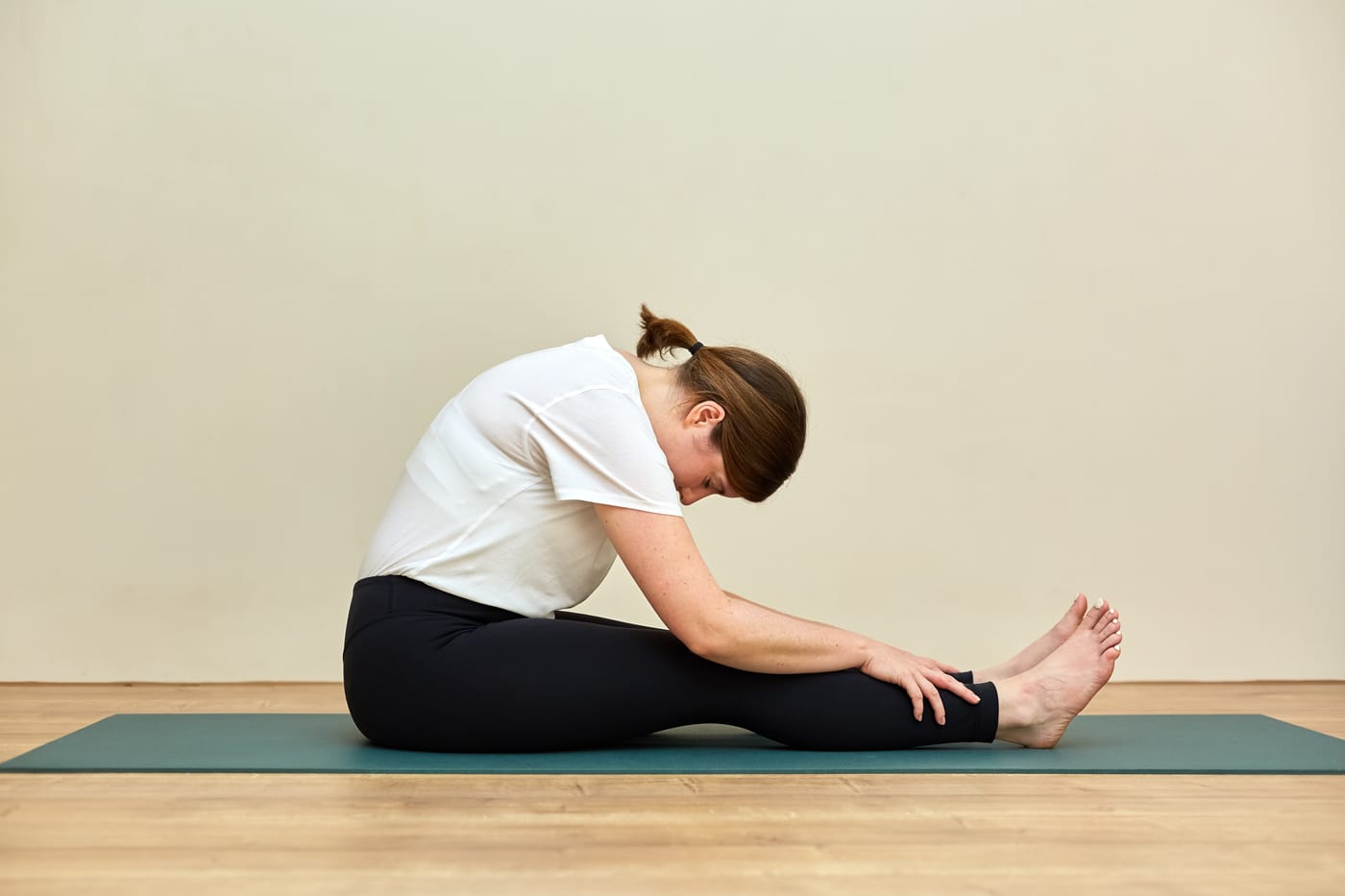
Stretch both legs out in front of you. Let the feet relax and fall open however they like.
On an out-breath, walk your hands forward and let your spine round gently. In Yin we allow the back to curl — you are folding from the whole spine, not just hinging at the hips.
Find your edge — about 60–80% of your capacity, a real stretch but never forcing. Then stop traveling forward and let the shape do the work. A broad pull along the backs of the legs and up the spine is soft-tissue tension and safe to soften into; anything sharp, pinching or electric is a signal to ease back, not push through.
Rest your hands wherever they land — on your shins, your feet, or the floor. If your head hangs a long way from your legs, slide a bolster onto your thighs and let your forehead melt down onto it.
Soften your neck, your jaw, your shoulders. Be still, and let each breath carry you a fraction deeper.
Why practice it
Gives the whole back line — from your heels, up the calves and hamstrings, all the way to the crown of your head — one long, quiet stretch.
Gently rounds and decompresses the spine, releasing tension held in the lower back after a busy day.
Stimulates the urinary bladder and kidney lines, which in the Chinese meridian tradition are linked to steadiness and calm.
Turns the attention inward. When your head drops toward your legs, the mind tends to soften and settle too.
Before you go
Want the follow-along version?
No spam, ever. Unsubscribe any time. I'll only send Yin.
Check your inbox 🌙 your two-hour retreat is on its way.
Take care
In Yin we let the spine round softly, but if you have disc trouble or sciatica, keep the knees bent, sit up higher on a cushion, and keep the back a little longer rather than deeply curled.
The sensation in the backs of the legs should feel like a broad stretch, never sharp or nervy. If it turns pinching or electric, ease back.
Bend your knees as much as you need — tight hamstrings are welcome here, and softening the knees lets the stretch reach your spine instead.
If you are pregnant, take the legs a little wider and fold only to a comfortable, open place with no compression through the belly.
Coming in & out
Into the pose
From a simple seated position, extend both legs straight out in front of you and pause before you fold.
Coming up from lying down, roll to sitting and stretch the legs forward.
Out of the pose
Come out slowly. Walk your hands back in toward your hips and, with a rounded back, roll yourself up to sitting one vertebra at a time.
Lean back on your hands and gently shake or bend the knees to release the legs.
Common questions
What does Caterpillar stretch?
Caterpillar works the whole back line — from the heels up through the calves and hamstrings and all the way along the spine. Unlike an active forward fold, the aim isn't to reach for the toes but to let the spine round softly, so the stretch is felt along the back body rather than pulled from the hamstrings alone.
How long do you hold Caterpillar in Yin Yoga?
Most people hold Caterpillar for 3–5 minutes. The long, still hold lets gravity draw you down gradually — settle in, let the head hang heavy, and soften a fraction deeper with each breath. Come out a little sooner if you need to.
Is Caterpillar safe with tight hamstrings or a sensitive lower back?
Yes, with a little set-up. Sit up on a folded blanket so your hips are higher than your knees, and bend the knees as much as you need — a bolster underneath supports them and lets the spine round instead. If a back condition means you shouldn't round the spine, or if you have sciatica, keep the back longer and sit higher, or choose another pose.
What's the difference between Caterpillar and Butterfly?
Both are seated Yin forward folds, but the legs differ. Caterpillar keeps the legs straight and together, folding along the whole back line. Butterfly brings the soles of the feet together with the knees dropping wide, so the focus shifts to the inner thighs and hips as you fold.
Caterpillar is one shape among many. When you'd like to put a whole sequence together into one long, slow practice, pop your email in and I'll send you my free two-hour Yin, restorative and Yoga Nidra retreat. Yours to keep.
No spam, ever. Unsubscribe any time. I'll only send Yin.
Check your inbox 🌙 your two-hour retreat is on its way.
Add this to your Home Screen: tap Share, then Add to Home Screen.