Child's Pose to round and release the upper back. · A slow shoulder roll or gentle arm circles to bring the shoulders back to neutral.
Time your hold
Three soft ticks and a bell when you're done, so you can close your eyes and stop watching the clock.
How to do it
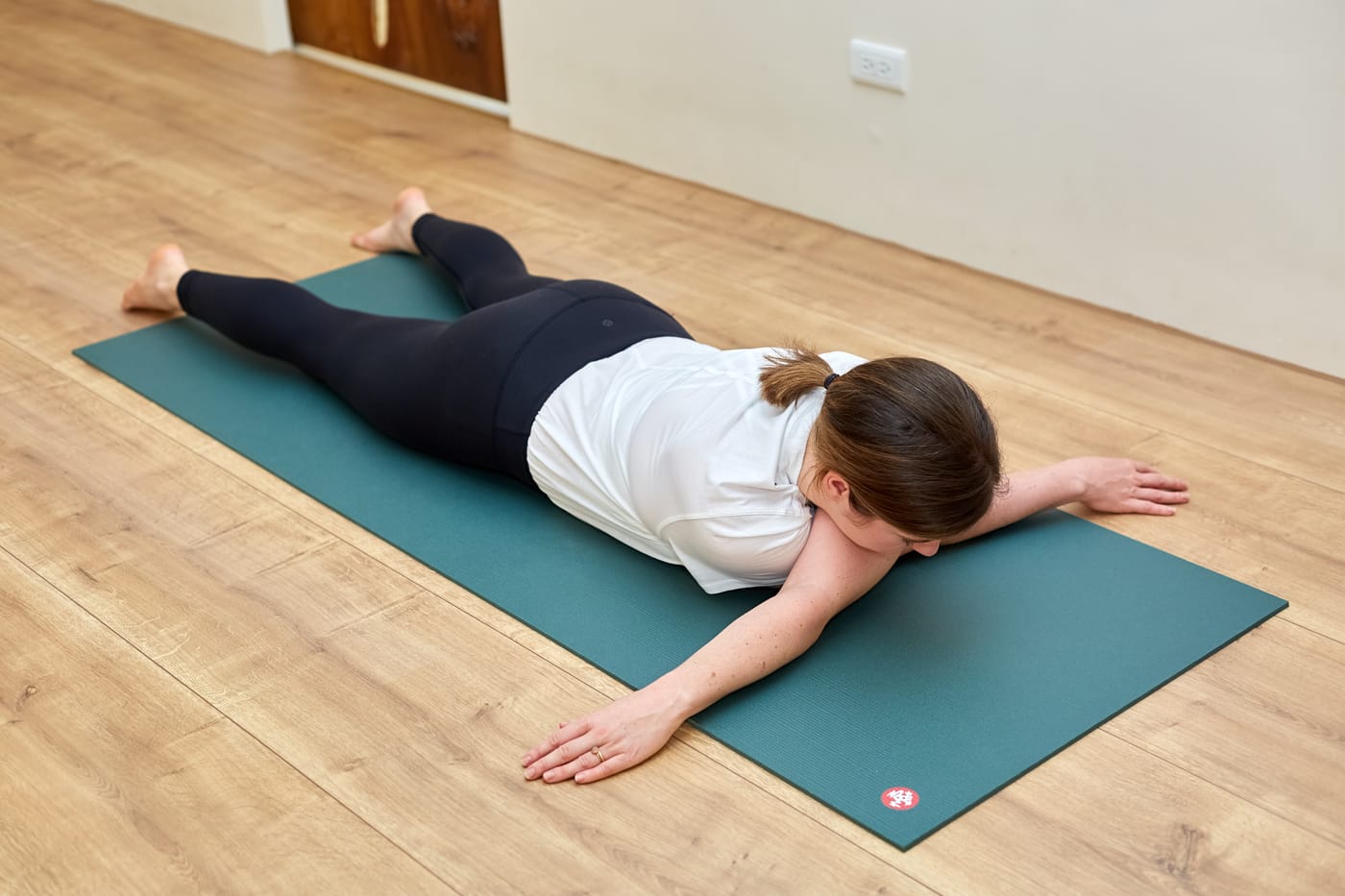
Lie face down and cross your arms underneath your chest, one forearm over the other, so the elbows point out to the sides like a bow tie.
Rest your forehead on the mat, or turn your head to one side, or set your chin down — whatever your neck prefers.
Let your chest sink toward the floor so the weight of your torso opens the shoulders.
The higher the arms are stacked toward the collarbones, the stronger the stretch — start lower and adjust.
How open the shoulders feel is partly down to your own build — everyone's shoulder joints are shaped a little differently, so let your body set the range rather than chasing a picture. This should be a soft stretch, never a sharp or pinching sensation in the joint.
Find your edge — about 60–80% of your capacity, a real stretch but never forcing — then let the shape do the work.
Swap which arm is on top halfway through, as the two arrangements feel quite different.
Cushion the forehead or the chest if you need a little more comfort.
Why practice it
Lets the weight of your own body open the shoulders and the space between the shoulder blades — no effort required.
Releases the upper back and the backs of the shoulders, easing rounded-forward posture.
Draws the shoulder blades apart, stretching the small and large intestine lines across the upper back.
Deeply restful — once you've settled, there is nothing to do but breathe.
Before you go
Want the follow-along version?
No spam, ever. Unsubscribe any time. I'll only send Yin.
Check your inbox 🌙 your two-hour retreat is on its way.
Take care
Go gently with any shoulder injury — this is a real load on the shoulder joint, so keep within a comfortable range.
If you feel any tingling or numbness down the arms, ease the arms lower or come out; the crossed position can compress the nerves.
Support the forehead or turn the head only as far as the neck is happy to go.
Coming in & out
Into the pose
From lying face down, cross the forearms beneath the chest and settle the torso onto them.
Out of the pose
Come out slowly — uncross the arms, bring the hands beside the chest, and press gently back to rest in Child's Pose.
Common questions
How long do you hold Bow Tie in Yin Yoga?
Most people hold Bow Tie for 3–5 minutes per arrangement. The long, still hold is what makes it Yin — settle in, soften, and let the shape do the work. Come out a little sooner if you ever need to.
Is Bow Tie suitable for beginners?
Bow Tie suits you best once you have a little Yin experience. It's still accessible if you ease in slowly, use props where you need them and respect the cautions on this page — never force the shape.
What does Bow Tie stretch?
Bow Tie mainly works the shoulders and the upper back, drawing the shoulder blades apart and opening across the backs of the shoulders. With the forearms crossed beneath you, your own body weight does the opening — there is nothing to hold or muscle into.
What's the difference between Bow Tie and Broken Wing?
They open different parts of the shoulder. Bow Tie has both arms crossed underneath you and works across the upper back and the backs of the shoulders. Broken Wing extends one arm out to the side and rolls the chest away, opening the front of the shoulder and the chest. Many practices use them together for an all-round shoulder release.
Bow Tie is one shape among many. When you'd like to put a whole sequence together into one long, slow practice, pop your email in and I'll send you my free two-hour Yin, restorative and Yoga Nidra retreat. Yours to keep.
No spam, ever. Unsubscribe any time. I'll only send Yin.
Check your inbox 🌙 your two-hour retreat is on its way.
Add this to your Home Screen: tap Share, then Add to Home Screen.