Rest face down with the forehead on stacked hands to let the shoulders settle. · Child's Pose or a gentle hug across the chest to bring the shoulders back to neutral.
Time your hold
Three soft ticks and a bell when you're done, so you can close your eyes and stop watching the clock.
How to do it
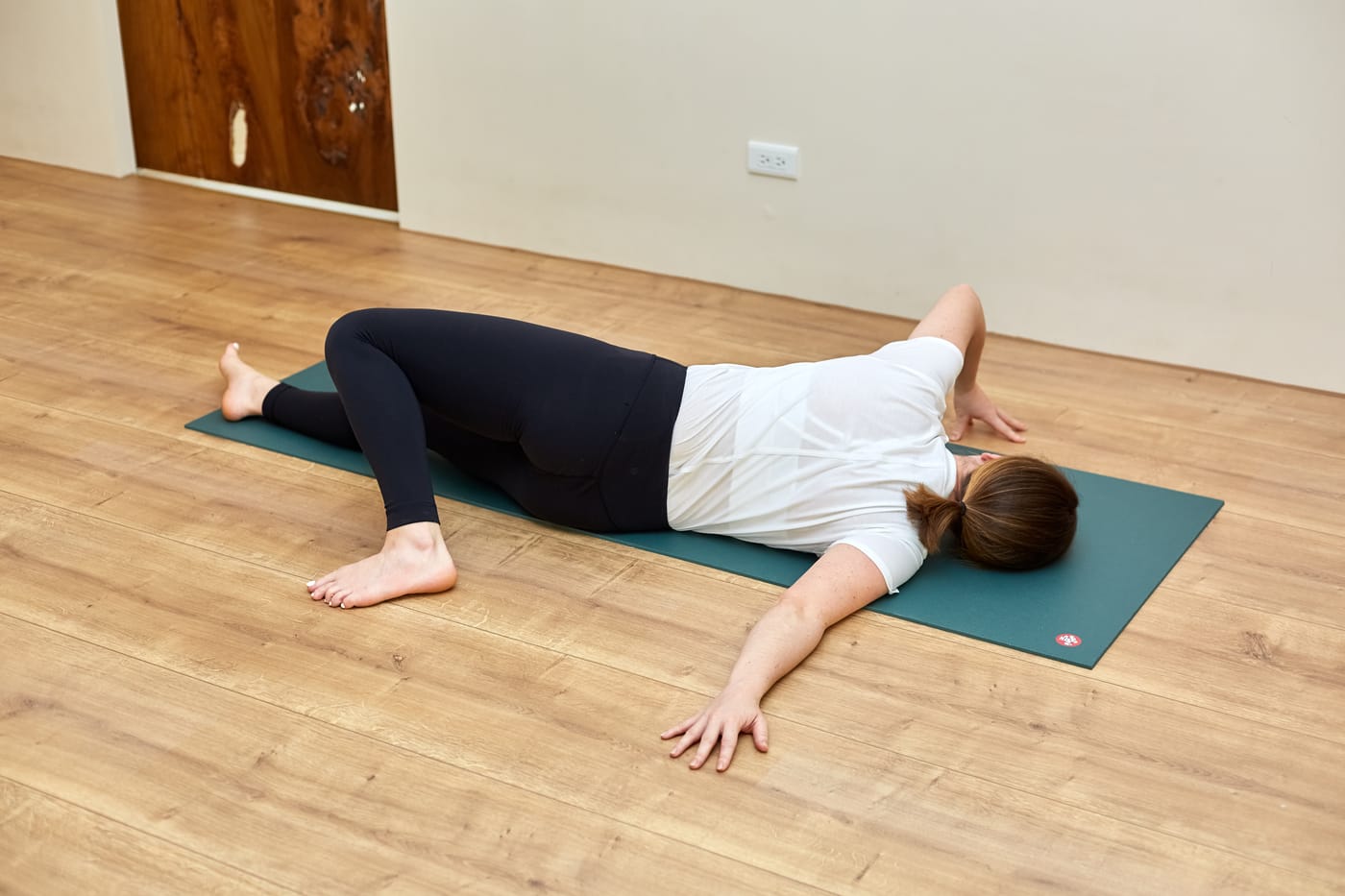
Lie face down and stretch your right arm straight out to the side at roughly shoulder height, palm down.
Bring your left hand under your shoulder and start to roll your chest and hips over toward the right, away from the extended arm.
Let the top of the left foot step over behind you to catch your balance, and rest the side of your head on the mat or a cushion.
Adjust the height of the extended arm — higher toward the head or lower toward the hip — to move the stretch around the shoulder and chest. Everyone's shoulder is built a little differently, so the angle that opens the front of your shoulder may not match the next person's; explore slowly to find yours.
Keep the sensation to a broad, soft stretch across the chest and front of the shoulder. Anything sharp, pinching or bone-on-bone at the front of the joint is a hard stop, not an edge to push through.
Find your edge — about 60–80% of your capacity, a real stretch but never forcing — then be still and let the shape do the work.
This one is intense, so give yourself permission to stay lighter than you think you should.
Why practice it
A strong opener for the front of the shoulder and the chest, reaching the pectoral muscles that rounded shoulders keep tight.
Stretches the lung and heart lines that run along the inner arm and across the chest.
Releases the front of the shoulder joint and eases forward-hunched posture.
Rolling the chest toward the mat lets gravity, not effort, do the opening.
Before you go
Want the follow-along version?
No spam, ever. Unsubscribe any time. I'll only send Yin.
Check your inbox 🌙 your two-hour retreat is on its way.
Take care
This is strong for the shoulder joint — come out slowly and stop straight away if there's any nerve tingling, numbness or shooting sensation down the arm.
Ease off with any shoulder injury or history of dislocation, and never push into pinching or pain at the front of the shoulder.
Build up the hold time gradually rather than diving straight to four minutes on your first visit.
Coming in & out
Into the pose
From lying face down, extend one arm out to the side and roll the chest toward that arm.
Out of the pose
Come out slowly — roll gently back onto your front, slide the arm in, and rest your forehead down for a few breaths before the second side.
Common questions
How long do you hold Broken Wing in Yin Yoga?
Most people hold Broken Wing for 2–4 minutes per side. The long, still hold is what makes it Yin — settle in, soften, and let the shape do the work. Come out a little sooner if you ever need to.
Is Broken Wing suitable for beginners?
Broken Wing suits you best once you have a little Yin experience. It's still accessible if you ease in slowly, use props where you need them and respect the cautions on this page — never force the shape.
What does Broken Wing stretch?
Broken Wing is a strong opener for the front of the shoulder and the chest, reaching the pectoral muscles that rounded, forward-hunched posture keeps tight. Changing the angle of the extended arm moves the stretch around different parts of the shoulder and chest.
What's the difference between Broken Wing and Bow Tie?
They open opposite sides of the shoulder. Broken Wing extends one arm out and rolls the chest away from it, opening the front of the shoulder and the chest. Bow Tie crosses both arms underneath you to open the upper back and the backs of the shoulders. They complement each other well in the same practice.
Broken Wing is one shape among many. When you'd like to put a whole sequence together into one long, slow practice, pop your email in and I'll send you my free two-hour Yin, restorative and Yoga Nidra retreat. Yours to keep.
No spam, ever. Unsubscribe any time. I'll only send Yin.
Check your inbox 🌙 your two-hour retreat is on its way.
Add this to your Home Screen: tap Share, then Add to Home Screen.