Stand tall and take a gentle backbend, hands supporting the lower back, to reverse the fold. · A slow standing side bend in each direction. · Lie down and hug the knees, or rest in Corpse pose.
Time your hold
Three soft ticks and a bell when you're done, so you can close your eyes and stop watching the clock.
How to do it
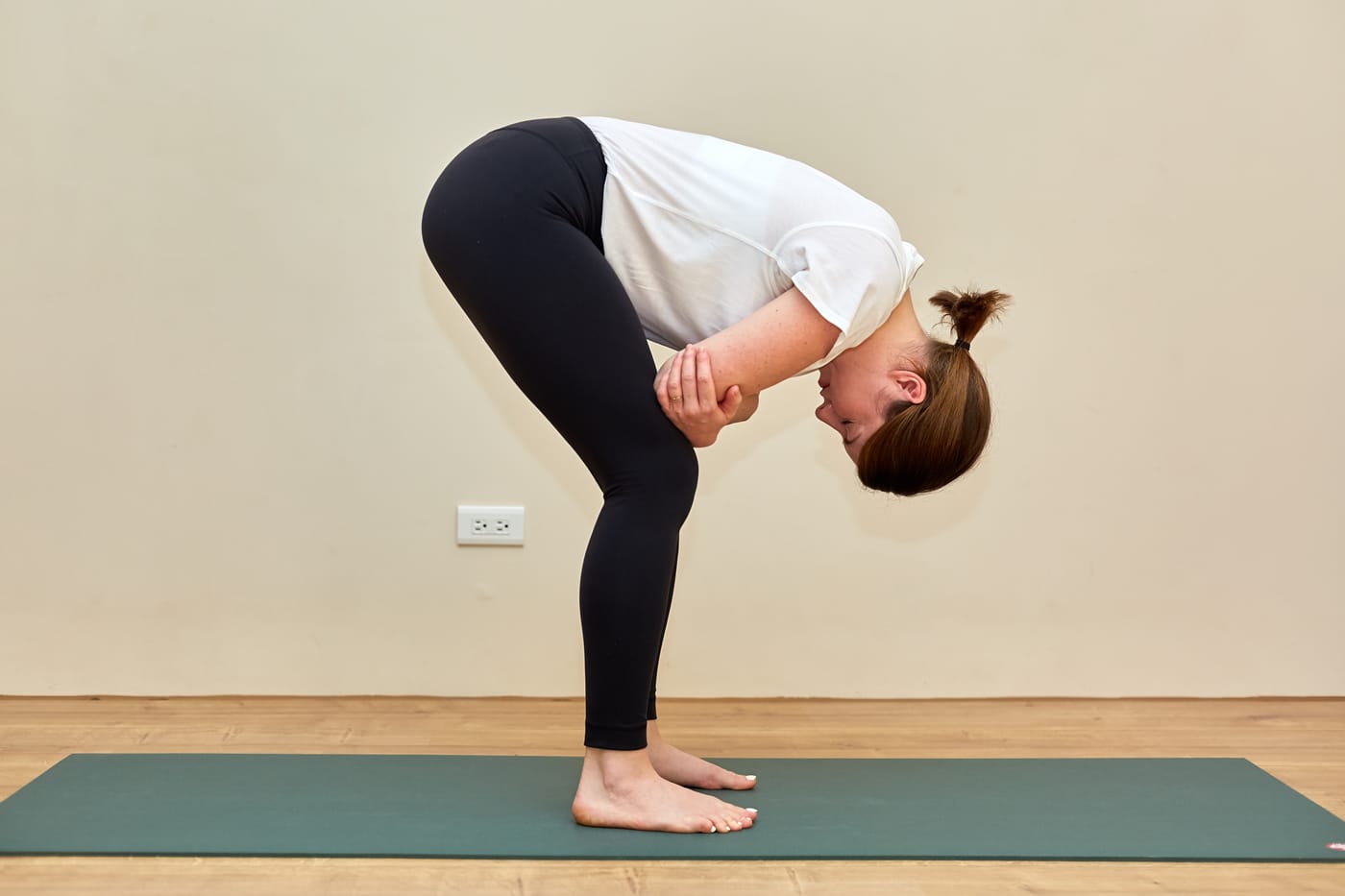
Stand with your feet about hip-width apart and soften your knees generously — a real bend, not locked and straight.
Fold forward from the hips and let your upper body hang down like a ragdoll. Let your head be heavy and your neck completely loose.
Hold opposite elbows and let your folded arms swing gently, or let the arms and hands simply dangle toward the floor.
Find your edge — about 60–80% of your capacity, a real stretch but never forcing. Bend the knees more to move the stretch into the lower back, or straighten them a little to reach the hamstrings.
Let the spine round and lengthen under its own weight. Be still and let the shape do the work.
If the floor feels far and reaching down strains you, rest your forearms or forehead on a bolster or a stack of blocks.
Why practice it
Uses gravity to decompress the whole back line and spine — the weight of your upper body does the work while you simply hang.
A deep, passive stretch for the hamstrings and lower back, lengthening the space between the vertebrae.
Stimulates the urinary bladder and kidney lines that run the length of the back and legs.
Wonderfully releasing after standing poses or a long day on your feet, and a rare Yin shape you can do almost anywhere.
Before you go
Want the follow-along version?
No spam, ever. Unsubscribe any time. I'll only send Yin.
Check your inbox 🌙 your two-hour retreat is on its way.
Take care
Come up slowly and with bent knees — rising quickly from a forward fold can make you light-headed or dizzy.
Bend the knees generously throughout. This keeps the stretch safe for the lower back and lets it reach the spine rather than straining the hamstrings.
With disc trouble or sciatica, keep the knees deeply bent and the fold shallow, or choose a supported seated fold instead.
If you have high or low blood pressure, or feel any head pressure, keep the head supported on a bolster and come up especially slowly.
Coming in & out
Into the pose
From standing, soften the knees and fold forward over the legs.
From Squat, straighten the legs part-way and let the torso hang.
Out of the pose
Come up slowly with the knees well bent, rolling up through a rounded spine one vertebra at a time — this protects the back and prevents dizziness.
Once standing, pause for a breath or two before you move on.
Common questions
How long do you hold Dangling in Yin Yoga?
Most people hold Dangling for 1–3 minutes. The long, still hold is what makes it Yin — settle in, soften, and let the shape do the work. Come out a little sooner if you ever need to.
Is Dangling suitable for beginners?
Yes. Dangling is a beginner-friendly Yin pose — approachable and easy to support. Work at about 60–80% of your edge, breathe, and read the cues and cautions on this page before you begin.
What does Dangling stretch?
Dangling mainly works the spine, hamstrings and lower back. Uses gravity to decompress the whole back line and spine — the weight of your upper body does the work while you simply hang.
Do you need props for Dangling?
You don't have to, but a bolster can make Dangling more comfortable and help you relax into the hold. Props in Yin aren't a shortcut — they let you stay longer and soften more deeply.
Should I keep my knees bent in Dangling?
Yes — bend them generously. In Yin, Dangling is about letting the lower back and spine release under the weight of the upper body, not straining the hamstrings. Bent knees soften the back line and move the fold into the lower back; straighten them only a little, and only if you want more hamstring sensation.
What's the difference between Dangling and Caterpillar?
They're the same forward fold in different orientations. Dangling is standing, so gravity draws the spine long; Caterpillar is the seated version folding over straight legs. Caterpillar is the gentler choice if standing forward folds feel too intense or you have blood-pressure concerns.
Dangling is one shape among many. When you'd like to put a whole sequence together into one long, slow practice, pop your email in and I'll send you my free two-hour Yin, restorative and Yoga Nidra retreat. Yours to keep.
No spam, ever. Unsubscribe any time. I'll only send Yin.
Check your inbox 🌙 your two-hour retreat is on its way.
Add this to your Home Screen: tap Share, then Add to Home Screen.