Child's Pose to release the hips and lower back · Downward-Facing Dog to lengthen the legs and neutralise
Time your hold
Three soft ticks and a bell when you're done, so you can close your eyes and stop watching the clock.
How to do it
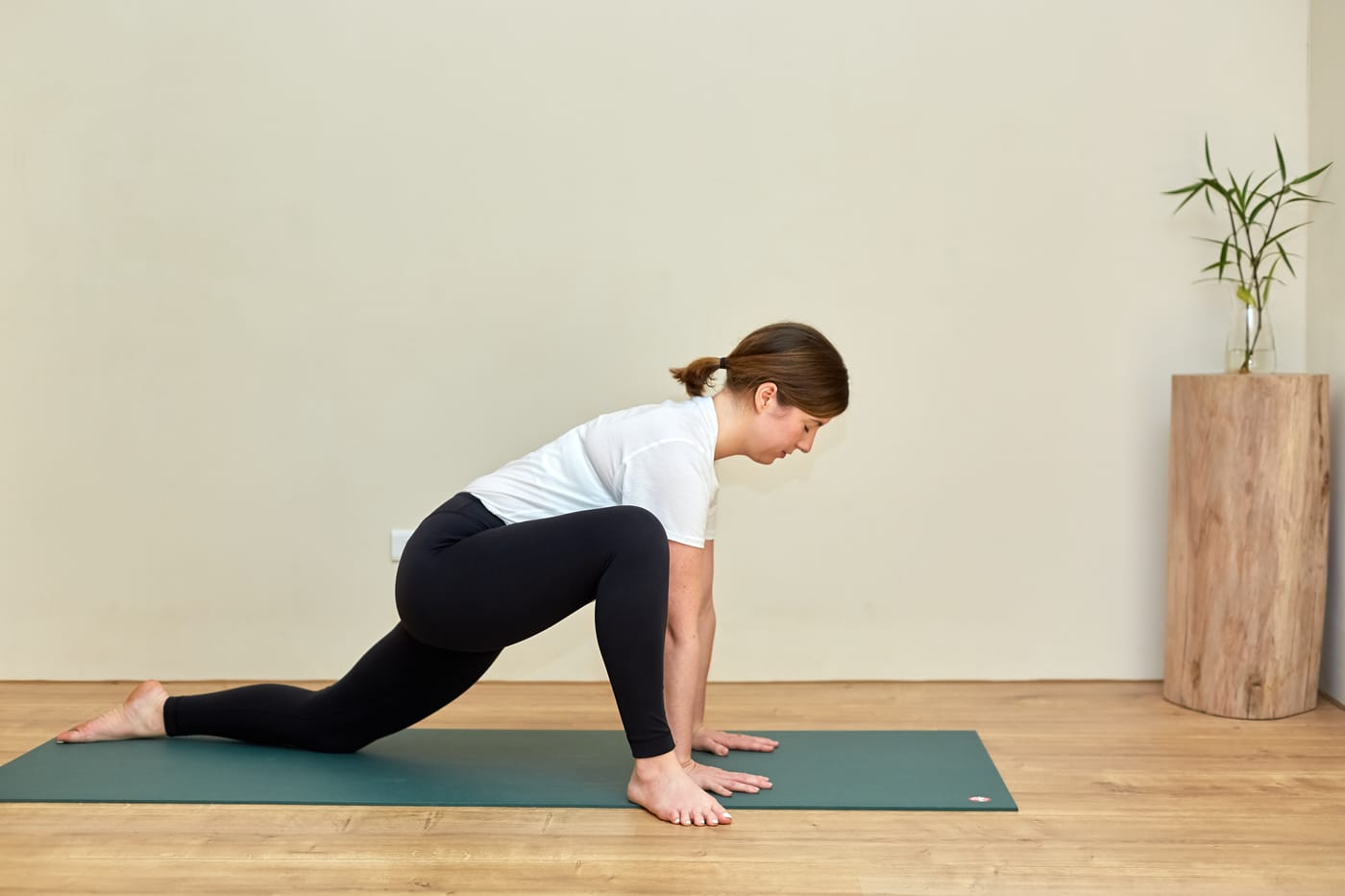
Come as you are. Begin on your hands and knees, then step your right foot forward between your hands.
Slide your left knee back until you feel a comfortable stretch through the front of the left hip and thigh. Rest the top of the back foot on the floor, or tuck the toes.
Pad the back knee with a folded blanket if the floor feels sharp against it.
Stack the front knee directly over the ankle — check that the knee stays above the heel, not pushing past the toes.
Let your hands frame the front foot, resting on the floor, on fingertips, or on a block. Let the hips sink and grow heavy. This is your base Dragon (sometimes called Baby Dragon).
For High Dragon: walk your hands back onto the front thigh and press down to lift the torso tall and upright, letting the hips keep sinking. Keep the tailbone heavy so you don't crunch the lower back.
For Low Dragon: walk your hands forward onto your forearms — on the floor, a block, or a bolster set inside the front foot — and let your head hang. If it's available, ease the front foot toward the edge of the mat and roll onto its outer edge to open the inner groin further.
Find your edge — about 60–80% of your capacity, a real stretch but never forcing. Keep the breath slow and easy.
Be still, and let the shape do the work. Stay, then step back and change sides.
Why practice it
A strong, grounding lunge that opens deep through the hip flexors and the front of the back thigh.
Releases the groin and the front hip as the pelvis sinks toward the floor.
Prepares the hips beautifully for deeper backbends and forward folds later in a practice.
Stimulates the Stomach, Spleen, Liver and Gall Bladder meridian lines.
A patient, weight-bearing shape — the parent pose from which the whole Dragon family unfolds.
Before you go
Want the follow-along version?
No spam, ever. Unsubscribe any time. I'll only send Yin.
Check your inbox 🌙 your two-hour retreat is on its way.
Take care
Protect the front knee. Keep it stacked over the ankle and tracking toward the middle toes — never let it drift past the toes or collapse inward.
Support the back knee with a folded blanket or the edge of your mat; bare kneecaps on a hard floor complain quickly.
If the front-of-hip stretch on the back leg feels too intense, ease the back knee forward a little or reduce how far the hips sink.
Come out slowly. Move gently into your counterpose and let the hips resettle before standing.
Coming in & out
Into the pose
From tabletop or Downward-Facing Dog — step one foot forward between the hands
From a standing forward fold — step one foot back into a low lunge
Out of the pose
Tuck the back toes and step the front foot back to tabletop or press up to Downward-Facing Dog.
Lower to Child's Pose to rest the hips.
Common questions
How long do you hold Dragon in Yin Yoga?
Most people hold Dragon for 2–5 minutes per side. The long, still hold is what makes it Yin — settle in, soften, and let the shape do the work. Come out a little sooner if you ever need to.
Is Dragon suitable for beginners?
Dragon suits you best once you have a little Yin experience. It's still accessible if you ease in slowly, use props where you need them and respect the cautions on this page — never force the shape.
What does Dragon stretch?
Dragon mainly works the hips, hip flexors, groin and quadriceps. A strong, grounding lunge that opens deep through the hip flexors and the front of the back thigh.
Do you need props for Dragon?
You don't have to, but a folded blanket or bolster can make Dragon more comfortable and help you relax into the hold. Props in Yin aren't a shortcut — they let you stay longer and soften more deeply.
What's the difference between Low Dragon and High Dragon?
They're the same lunge with a different upper body. In High Dragon you lift the torso tall over the sinking hips; in Low Dragon you fold forward onto your forearms for a deeper groin and hip-flexor stretch. Start in the base Dragon and choose whichever your body wants that day.
Is Dragon safe for the knees?
It can be, with a little care. Pad the back knee with a folded blanket or slide a bolster under the shin so bare kneecap isn't pressing into a hard floor. Keep the front knee stacked over the ankle and tracking toward the middle toes. The front-of-hip stretch on the back leg is soft-tissue tension you can slowly explore, but sharp knee sensation is a signal to back off.
Dragon is one shape among many. When you'd like to put a whole sequence together into one long, slow practice, pop your email in and I'll send you my free two-hour Yin, restorative and Yoga Nidra retreat. Yours to keep.
No spam, ever. Unsubscribe any time. I'll only send Yin.
Check your inbox 🌙 your two-hour retreat is on its way.
Add this to your Home Screen: tap Share, then Add to Home Screen.