

the journal · for runners
What to Do After a Run: A Simple 15-Minute Post-Run Stretch Routine
fifteen quiet minutes, while you're still warm
You know the scene. You finish a good run — legs heavy, hips tight, that familiar pull down the back of your thigh. You mean to stretch. You check your watch instead, and head for the shower.
I get it. Nobody ever made the stretching part simple, so it quietly slides — run after run — and the tightness stacks up. Hips one month, calves the next. Then one morning your stride feels short and braced, and you’re wondering where your easy miles went.
Here’s the good news: undoing it doesn’t take much. Fifteen unhurried minutes, in the right shapes, often enough. That’s genuinely most of it. Here’s exactly what to do.
Why after a run, not before
There’s a lot of confusing advice about runners and stretching, so let me keep it plain.
Before a run, your body wants to be woken up, not lengthened — a few minutes of easy movement does that. Long, deep holds right before you run can actually leave you feeling a little loose and less powerful. So we save them for later.
After a run is when the long, still holds earn their keep. You’re warm, the work is done, and this is the moment to give back the range running quietly takes away — and to let your body shift down into its rest state, which is the recovery half of training most runners skip.
Why fifteen minutes is enough
This is Yin yoga, and all it really means is this: you settle into a shape and stay for a few quiet minutes — nothing forced, only ever to about 60–80% of your capacity — and let gravity and your breath do the slow work a rushed stretch can’t reach.
A hurried thirty-second stretch barely touches the deeper tissue around your hips and joints. That tissue responds to time, not effort. Which is oddly freeing: you don’t have to work hard here. You mostly have to stay.
You don’t need to become flexible. You just need to stop getting tighter.
The routine
Four shapes, and that’s genuinely all. Take a slow half-minute between them — that pause is part of the practice, not a gap in it. If you only have five minutes, do the first two; they’re where runners hold the most.
1. Dragon — for the hip flexors. A low lunge, back knee down. Running plus sitting all day shortens the front of the hip more than anywhere else, so we open it first. Let the hips sink toward the floor and breathe. Two minutes each side.
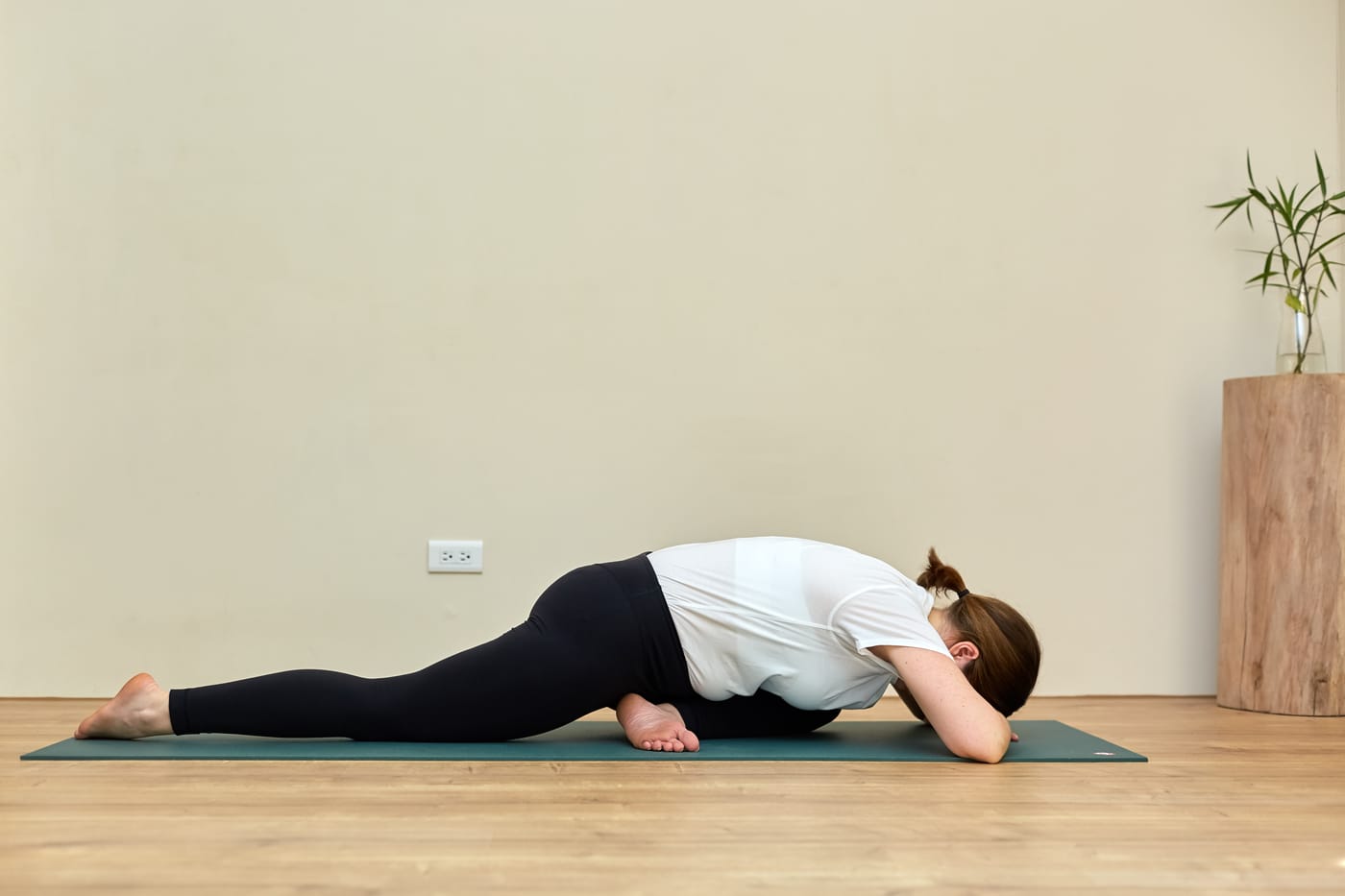
2. Sleeping Swan — for the glutes and outer hip. Front shin angled across the mat, back leg long, then fold forward over the front leg. This is the one runners tend to feel most. Ease in slowly. Two minutes each side.
3. Caterpillar — for the hamstrings and the whole back line. Both legs long, and a slow fold over them with the back rounded and the head heavy. Your hamstrings do the hardest braking work in every stride, so give them their length back — softly, no yanking. Two minutes.
4. Reclined Twist — for the lower back, and to settle. On your back, draw the knees across your body and let them drop. Every run is impact your spine absorbs; this gently undoes the day’s compression, and it’s a lovely place to finish. One minute each side.
That’s the whole thing. Hips, glutes, hamstrings, spine — the chain running tightens, in about fifteen minutes.
Making it stick
The routine that helps is the one you actually do. So keep the bar low: roll out your mat after your next run, do what you remember, and let it be imperfect. Little and often beats long and rare every single time — showing up is what quietly moves the needle.
A gentle note: this is general education, not medical advice. Yin helps with everyday tightness — it doesn’t treat or prevent injury, and sharp or lasting pain belongs with a physio or doctor.
Want it as a follow-along?
If you’d rather be talked through it than read a list, I’ve made a free 15-minute Post-Run Reset — these exact four shapes, guided, so you can just press play after a run and follow along. You can grab it here.
And if it clicks and you want the whole system — a short practice for every place running tightens, plus guided plans — that’s what The Runner’s Reset is. No rush. Start with the free class and see how your legs feel.
Take good care of yourself, Katie
New to all this? Start with the fuller guide: Yoga for Runners — or go straight to the classes: Yin Yoga for Runners.
While you're here
Want the follow-along class?
No spam, ever. Unsubscribe any time. I'll only send Yin.
Check your inbox 🌙 your Post-Run Reset is on its way.
Common questions
Should I stretch before or after a run?
After is the sweet spot — while you're still warm. Keep anything before a run short and gentle; long, deep holds right before running can leave you feeling a little loose and less powerful, which isn't what you want at the start line.
How long should I hold each stretch?
A couple of quiet minutes is where the good stuff happens. The deeper tissue around your hips and joints doesn't respond to a quick pull — it responds to time. Settle in to about 60–80% of your range and let the shape soften from there.
I'm not flexible at all — can I still do this?
Yes, and honestly that's the whole point. This isn't about how far you fold. Every shape has a gentler version, and tight runners are exactly who it's for.
How soon after a run should I do it?
Whenever suits you while you're still warm — straight after, or that evening as you wind down. Little and often does far more than long and rare.
Will stretching after running prevent injury?
It can ease the everyday tightness that builds up run after run, and that helps you move more freely — but it isn't a guarantee against injury, and it's no substitute for sensible training and rest. Sharp or lasting pain belongs with a physio.
From the mat
Ready to actually practice?
✦ A free follow-along class, with a hold timer
Reading about it is one thing — feeling it is another. Pop your email in and I'll send you my free 15-Minute Post-Run Reset: a follow-along Yin class for after your run, with a hold timer and written cues. Yours to keep.
No spam, ever. Unsubscribe any time. I'll only send Yin.
Check your inbox 🌙 your Post-Run Reset is on its way.