

the journal · for runners
Yoga for Runners: The Best Yin Poses for Tight Hips, Hamstrings & Recovery
keep running for years, not seasons
If you run, you already know the feeling: you finish a good run with heavy legs, tight hips and that familiar pull down the back of your leg. You mean to stretch. Usually you don’t. And it quietly stacks up — run after run — until a niggle turns into “maybe I’ll take a week off.”
That slow build-up of tightness is where most running injuries actually begin. And it’s exactly what a short, slow Yin practice is made to undo. Here’s how Yin helps runners, the poses that matter most, when to do them, and a few follow-along classes you can try tonight.
Is yoga good for runners?
Running makes you fitter and stronger — and it also repeatedly loads the same chain of tissues: your hips, hamstrings, glutes, calves, quads and lower back. Over weeks, that repetition shortens and stiffens the very things that keep you running well. Recovery and mobility are the neglected half of training, and Yin fits that gap neatly.
Yin Yoga is slow and still. You settle into a shape and stay for a few quiet minutes, letting gravity and your breath do the work — nothing forced. Those long, unhurried holds are what reach the deeper tissue around the hips and joints that a quick 30-second stretch or a foam-roll only skims.
None of this replaces good coaching or physiotherapy, and it won’t “cure” an injury — but for the everyday tightness running builds, it genuinely helps you move more freely and recover feeling less stiff.
How does Yin Yoga help runners?
Two things do most of the work:
- Range of motion. Staying in a shape for two to five minutes gently improves how far your hips, hamstrings and ankles can move — mobility that running slowly erodes.
- Recovery. The long, quiet holds shift you toward your body’s rest state. You come away feeling calmer and less braced — the recovery half of training that runners so often skip.
You don’t need to become flexible. You just need to stop getting tighter.
The best Yin Yoga poses for runners
Running doesn’t tighten one thing — it tightens a chain, so it’s worth working each link. Each pose below links to a full guide with cues and how long to hold it.
For tight hips & hip flexors — the runner’s tightest link, made worse by sitting all day:
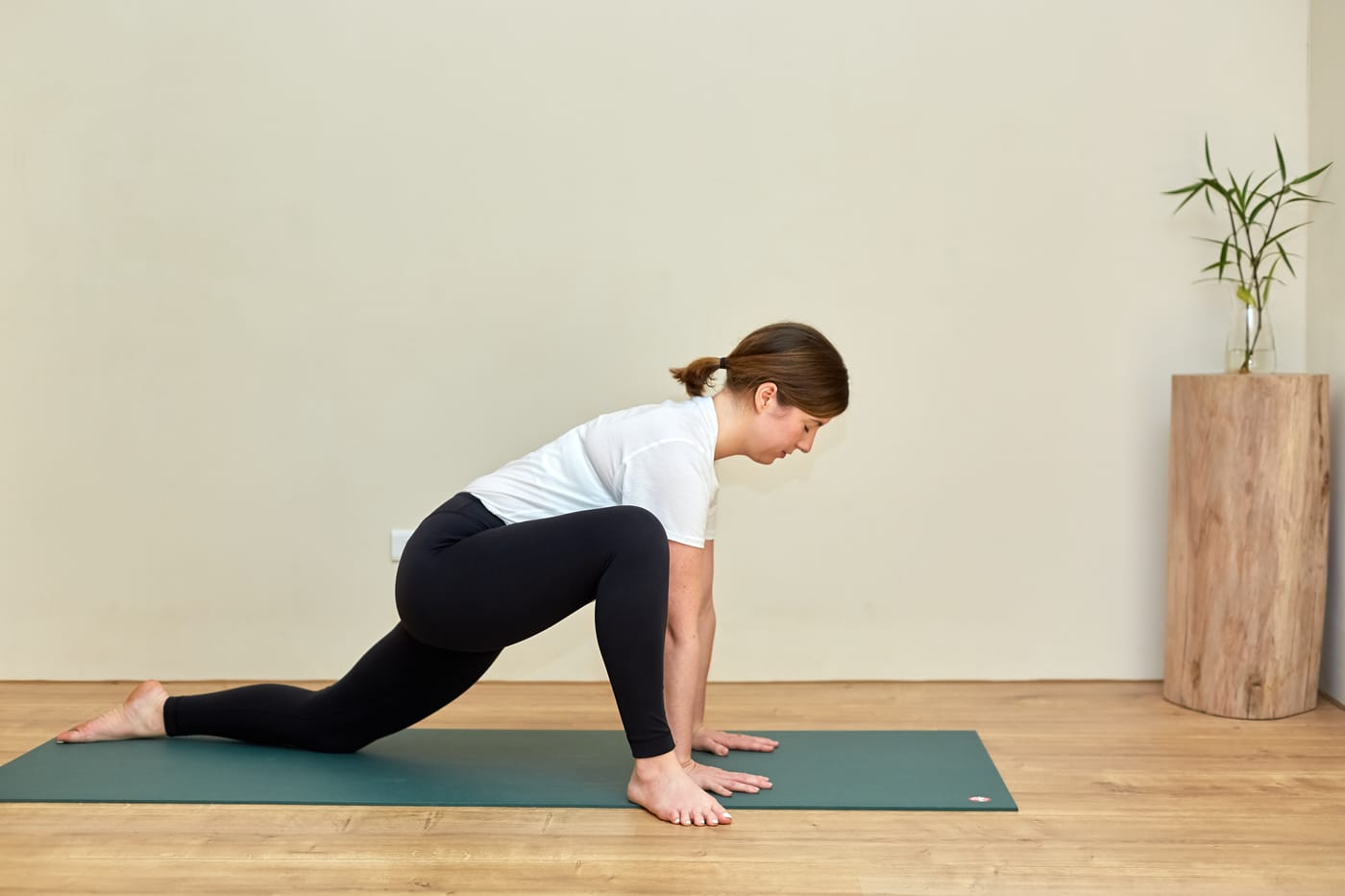
- Dragon — a deep low lunge, the big hip-flexor opener.
- Sleeping Swan — releases the glute and deep outer hip.
For hamstrings & glutes — the muscles that do the hard braking in every stride:
- Caterpillar — a long, calming fold down the whole back body.
- Half-Butterfly — targets one hamstring at a time.
For calves, ankles & feet — the base most runners never work:
- Toe Squat — wakes up the soles and toes.
- Squat and Ankle Stretch — free the ankles both ways.
For quads & the outer hip — the tissues behind most “IT band” complaints:
- Saddle — a deep opener for the fronts of the thighs (ease in gently, and skip it if your knees or back object).
- Twisted Dragon — into the outer hip and the muscles that tension the IT band. (You can’t stretch the IT band itself — it’s a tough band of fascia — but you can release what pulls on it.)
For the lower back — compressed by every run:
- Sphinx and Reclined Twist — gentle extension and rotation to undo the day’s compression.
If that list feels like a lot
It is a lot — which is why I’d start with four of them rather than ten. Dragon, Sleeping Swan, Caterpillar and Reclined Twist: one for the front of the hip, one for the glute, one for the hamstrings, one for the spine. Between them they cover the whole chain.
Those four are the entire contents of my free 15-Minute Post-Run Reset — guided, so you don’t have to remember any of this. If you’d rather read the routine than watch it, it’s written out step by step in what to do after a run.
When should runners do yoga?
Timing matters more than most runners realize:
- After a run is the sweet spot — you’re warm, and the tightness releases before it settles in. Even ten quiet minutes counts.
- On rest days, a longer session resets the whole lower body.
- Not deep stretching right before a run. Long, passive holds are lovely for recovery, but done immediately before running they can leave you feeling loose and a little less powerful. Save the deep Yin for after and for rest days; keep anything pre-run short and gentle.
Little and often does far more than long and rare.
Follow-along Yin classes for runners
If you’d rather just roll out your mat and follow along, here are a few of my classes runners come back to most:
- Pre-Run Yoga (10 minutes) — a gentle warm-up to move more freely from the first step.
- After-Running Yoga (10 minutes) — a short post-run reset.
- Deep Stretch Yoga for Runners (30 minutes) — a fuller recovery-day practice.
- Runner’s Yoga to Boost Recovery (35 minutes) — for stiff, sore legs after a hard session.
Those four are the ones written for runners. There are another eighteen in the library that runners get a lot out of even though the titles don’t say so — legs, glutes, hip flexors, tired feet — and I’ve gathered the lot on one page: Yin Yoga for Runners, in the order I’d hand them to you.
And if it clicks and you want the whole thing laid out — a short practice for every place running tightens, longer resets for rest days, and plans that tell you what to press play on — that’s what The Runner’s Reset is. No rush at all. Start with the free class and see how your legs feel first.
Whatever you do, be kind to the body that carries you through every mile. Roll out your mat after your next run, give it fifteen slow minutes, and come back to it often — that quiet habit is what keeps you running for years, not just for now.
Take good care of yourself, Katie
While you're here
Want the follow-along class?
No spam, ever. Unsubscribe any time. I'll only send Yin.
Check your inbox 🌙 your Post-Run Reset is on its way.
Common questions
Is yoga good for runners?
Yes — for mobility and recovery especially. The long, slow holds gently ease the tightness running builds up in the hips, hamstrings and calves, and help you feel less stiff.
Should runners do yoga before or after running?
After a run and on rest days is the sweet spot, while you're warm. Keep anything before a run short and gentle — long, deep holds right before running can leave you feeling a little loose and less powerful.
How often should a runner do yoga?
A couple of short sessions a week, plus one longer session on a rest day, is plenty to keep the tightness from building up.
Can yoga help tight hips from running?
Yes — this is where it shines. Running plus sitting shortens the hip flexors, and long Yin holds gently open them back up so your stride feels freer.
Will yoga prevent running injuries?
It can ease the everyday tightness that contributes to overuse niggles, which helps — but it's not a guarantee, and it isn't a substitute for good training and rest. If you have sharp or lasting pain, see a physio.
From the mat
Ready to actually practice?
✦ A free follow-along class, with a hold timer
Reading about it is one thing — feeling it is another. Pop your email in and I'll send you my free 15-Minute Post-Run Reset: a follow-along Yin class for after your run, with a hold timer and written cues. Yours to keep.
No spam, ever. Unsubscribe any time. I'll only send Yin.
Check your inbox 🌙 your Post-Run Reset is on its way.