Dangling or a soft standing forward fold to lengthen the backs of the legs. · A gentle seat with the legs extended, such as Caterpillar.
Time your hold
Three soft ticks and a bell when you're done, so you can close your eyes and stop watching the clock.
How to do it
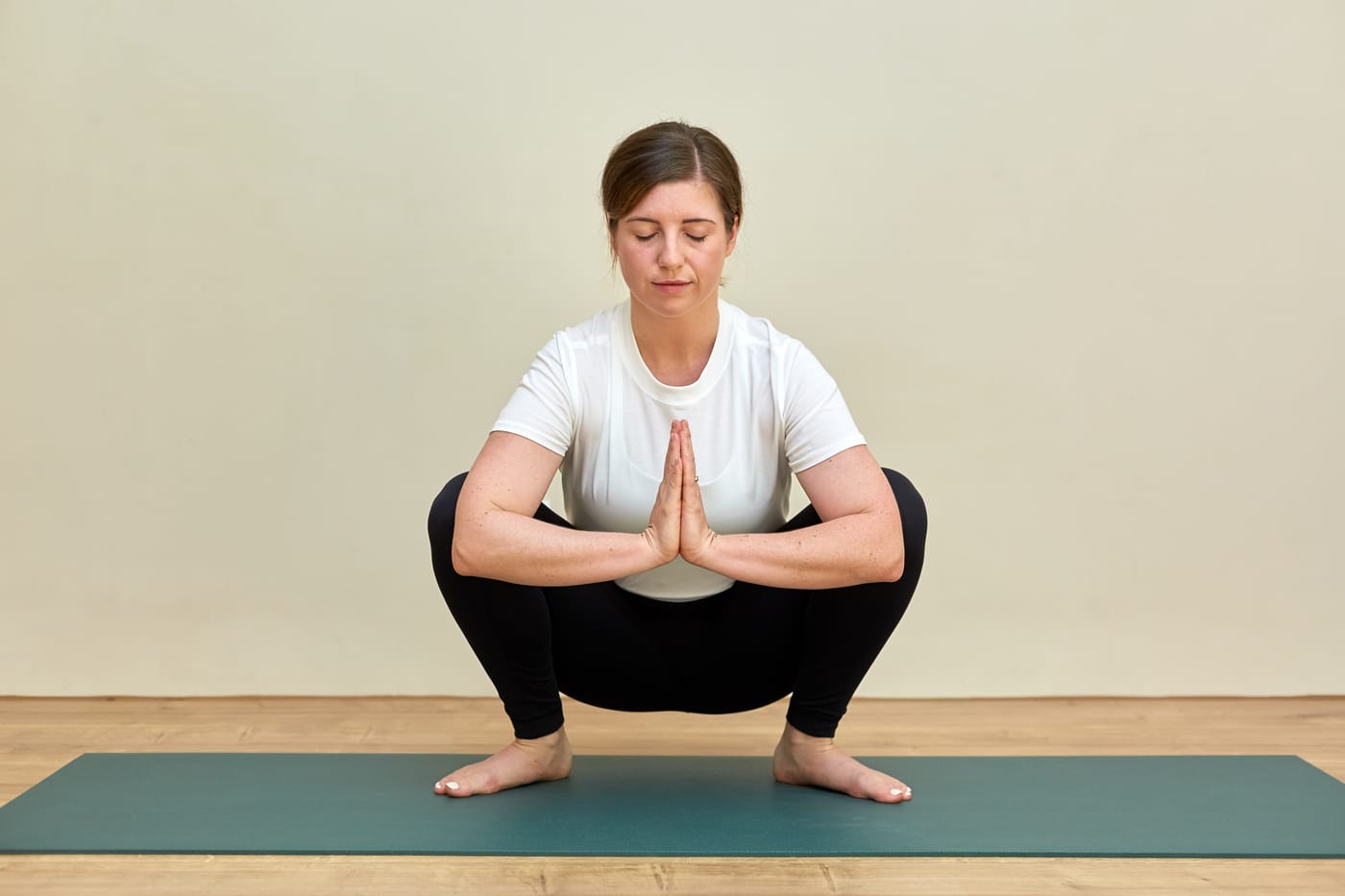
Stand with your feet a little wider than your hips and turn your toes out slightly. Bend your knees and sink your hips low toward the floor.
Let your heels stay down if they will; if they lift, sit them on a rolled mat or blanket so you can settle in.
Bring your hands together at your chest and use your elbows to gently ease the knees wider, or simply let your arms hang.
Find your edge — about 60–80% of your capacity, a real stretch but never forcing. Soften and let the shape do the work.
If sinking all the way down is too much for the knees, perch on a block or bolster and let it hold some of your weight.
Why practice it
Opens the hips and inner groin deeply as the hips sink low between the thighs.
Stretches the ankles and the whole lower leg, waking up joints we rarely take to their full range.
Gently lengthens and decompresses the lower back as you round forward and let the spine hang.
A wonderfully grounding shape that connects you to the earth beneath you.
Before you go
Want the follow-along version?
No spam, ever. Unsubscribe any time. I'll only send Yin.
Check your inbox 🌙 your two-hour retreat is on its way.
Take care
If the hips are tight, the pressure can travel into the knees. Keep the knees and toes pointing the same way, widen the feet if you need to, and back off the depth if you feel anything in the knee joint itself.
If you have injured or unstable knees, approach with great care or choose a hip opener that keeps the knees more open, like Butterfly.
Come up slowly to avoid feeling light-headed after a long hold low to the ground.
Coming in & out
Into the pose
From standing, step your feet a little wider than your hips and slowly lower your hips down into the squat.
From Dangling (a standing forward fold), bend your knees and sink your hips down.
Out of the pose
Come out slowly. Either sit down onto the floor, or press through your feet to rise, or drop the knees to come to Table.
If you have been down a while, straighten the legs gradually to let the knees adjust.
Common questions
What does Squat stretch in Yin Yoga?
Squat mainly opens the hips and inner groin as the pelvis sinks low between the thighs, and it stretches the ankles and lower leg. Rounding forward also lets the lower back lengthen. Wider feet work more into the hips; feet closer together works more into the ankles.
How long do you hold Squat in Yin Yoga?
Most people hold Squat for 1–3 minutes, and you can revisit it a couple of times in a practice. The long, still hold is what makes it Yin — settle in, soften, and come out a little sooner if you ever need to.
Why do my heels lift in Squat, and how do I fix it?
Lifting heels usually mean the ankles have reached their limit, and how far they bend is partly down to your own bone structure — your body, your yoga. There's no need to force them down. Rest the heels on a rolled mat or folded blanket, or step the feet a little wider, so you can relax and settle into the hold.
Is Squat safe for the knees?
For most people, yes, as long as the knees and toes point the same way and you feel the work in the hips, not the knee joint. If the hips are tight the pressure can shift into the knees — widen the feet, sit up onto a block, or ease off the depth. Take great care, or skip it, with a knee injury.
Squat is one shape among many. When you'd like to put a whole sequence together into one long, slow practice, pop your email in and I'll send you my free two-hour Yin, restorative and Yoga Nidra retreat. Yours to keep.
No spam, ever. Unsubscribe any time. I'll only send Yin.
Check your inbox 🌙 your two-hour retreat is on its way.
Add this to your Home Screen: tap Share, then Add to Home Screen.