Extend the legs long in Caterpillar or gently shake them out to release the hips. · A soft twist to free the spine after sitting.
Time your hold
Three soft ticks and a bell when you're done, so you can close your eyes and stop watching the clock.
How to do it
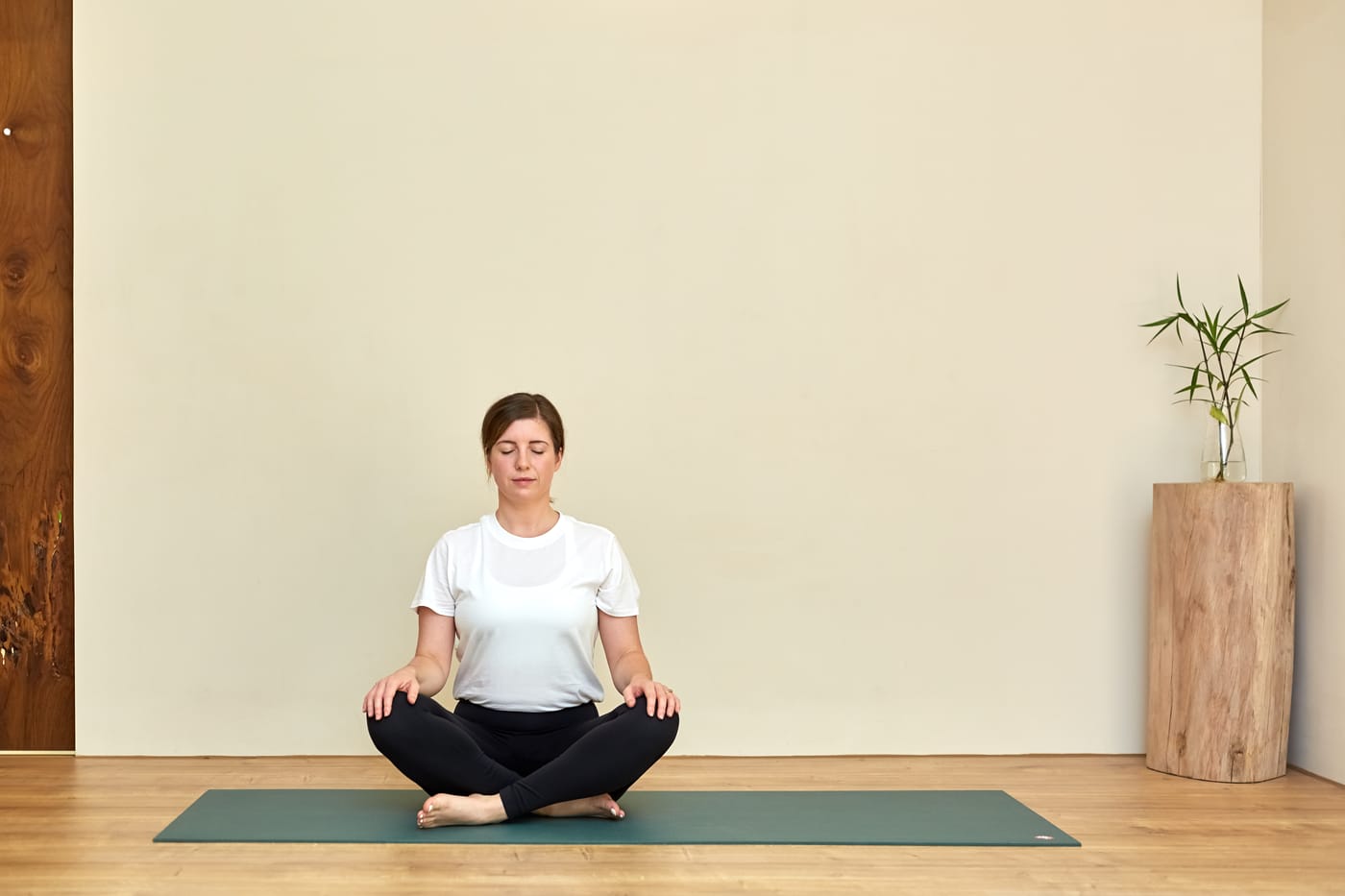
Sit cross-legged, letting each foot rest beneath the opposite knee, and settle onto your sitting bones.
Sit up onto the edge of a cushion or folded blanket so the hips lift above the knees — this lets the spine rise easily.
Rest your hands on your thighs or in your lap, soften your shoulders, and let the crown of your head float up.
Come as you are. There is nothing to achieve here — simply breathe and be still.
If the knees hang high or the outer hips feel tight, support each knee on a cushion or block so they can relax.
Why practice it
A simple, comfortable seat for breathing and meditation, and a grounding way to begin or close a practice.
Crossing the legs is a gentle outward rotation of the hips — the mild, everyday version of deeper hip openers like Square (Fire Log) or Shoelace.
Invites the spine to grow tall and the breath to move freely, which helps you feel calm and settled.
Teaches the stillness at the heart of Yin — sitting quietly and simply being here.
Before you go
Want the follow-along version?
No spam, ever. Unsubscribe any time. I'll only send Yin.
Check your inbox 🌙 your two-hour retreat is on its way.
Take care
If the knees feel any strain, raise your seat higher and support the knees on cushions so they are not left hanging.
Sitting on the floor may be hard on the lower back for some — lift the hips more, or sit against a wall for support.
Change the crossing of the legs regularly so one hip is not always working harder than the other.
Coming in & out
Into the pose
From standing or kneeling, come down to sit and cross the legs comfortably.
Out of the pose
Come out slowly. Uncross the legs, extend them forward and give the knees a moment before you move on.
Swap the cross of the legs from time to time so both sides share the work.
Common questions
How long do you hold Easy Pose in Yin Yoga?
Most people hold Easy Pose for as long as comfortable. The long, still hold is what makes it Yin — settle in, soften, and let the shape do the work. Come out a little sooner if you ever need to.
What does Easy Pose stretch?
Easy Pose is mostly a resting seat rather than a strong stretch. The cross-legged shape gently rotates the hips outward and lets the spine grow tall — enough to feel a soft opening in the outer hips, especially if the knees sit high.
Why do my knees lift up when I sit cross-legged?
That's your hips, not a lack of effort — how far the knees drop depends on your own hip joints. Never force them down. Sit up on a cushion so the hips are higher than the knees, and support each knee on a block or cushion so the outer hips can soften.
What's the difference between Easy Pose and Square (Fire Log) Pose?
Same idea, different intensity. Easy Pose is a relaxed cross-legged seat where the feet tuck near the shins. Square stacks one shin over the other to load the outer hips much more strongly. If a simple cross-legged seat already feels like plenty in your hips, that's your version of Square — stay and enjoy it.
Easy Pose is one shape among many. When you'd like to put a whole sequence together into one long, slow practice, pop your email in and I'll send you my free two-hour Yin, restorative and Yoga Nidra retreat. Yours to keep.
No spam, ever. Unsubscribe any time. I'll only send Yin.
Check your inbox 🌙 your two-hour retreat is on its way.
Add this to your Home Screen: tap Share, then Add to Home Screen.