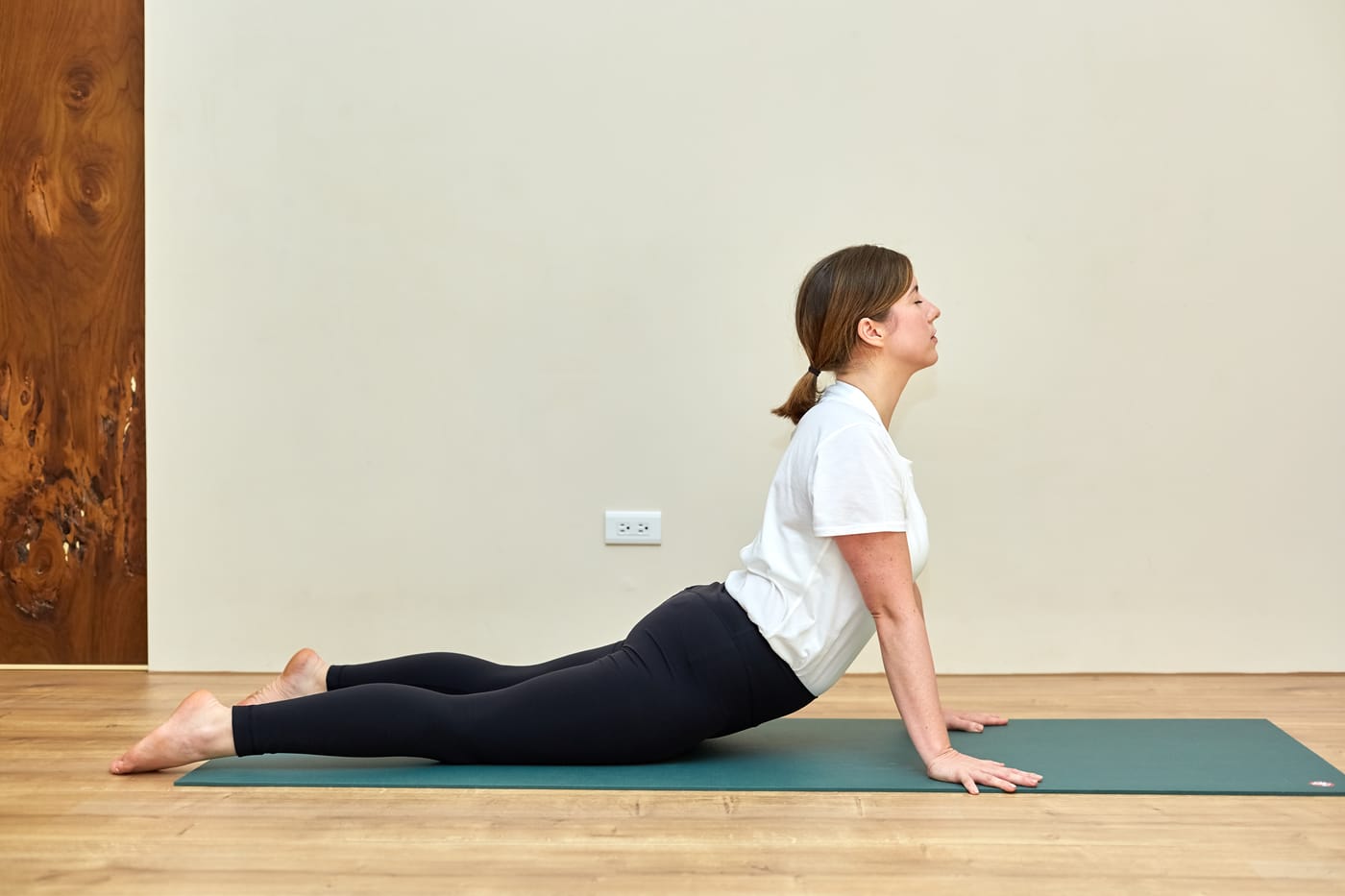
Child's Pose, moved into slowly · Resting on the belly with one knee drawn up to release the lower back
Time your hold
Three soft ticks and a bell when you're done, so you can close your eyes and stop watching the clock.
How to do it
Begin lying on your belly. Press your hands into the floor slightly forward of your shoulders and straighten your arms to lift the chest.
Turn the hands out a little and let the shoulders soften down, so the arch pours into the spine rather than hunching the shoulders up.
Let the belly and legs stay heavy on the floor, and allow the spine to hang into the backbend rather than gripping to hold it.
Find your edge — about 60–80%, a real stretch in the lower back but never a forcing. If it is too strong, drop down to Sphinx on the forearms instead.
Keeping the legs apart deepens the low-back sensation; together spreads it more evenly along the spine.
Seal is strong, so work in shorter rounds if you need to — a minute or two, rest on the belly, then come back. Let the shape do the work.
Why practice it
A deeper backbend than Sphinx that draws a strong, tonifying compression into the sacral-lumbar arch.
Restores and strengthens the natural curve of the lower back, often feeling wonderful for a spine that spends its days rounded forward.
Stimulates the kidneys and adrenals, working the Kidney and Urinary Bladder lines together with the Stomach and Spleen meridians.
With the arms straighter and the chest lifted higher, it opens the front body more fully than Sphinx — the deeper option once Sphinx feels easy.
Before you go
Want the follow-along version?
No spam, ever. Unsubscribe any time. I'll only send Yin.
Check your inbox 🌙 your two-hour retreat is on its way.
Take care
Ease off — or come out — at any sharp sensation in the lower back. Seal is a strong backbend, and sharp pain is a stop signal.
If the lower back feels compressed or pinched, come down to Sphinx, which offers the same benefits more gently.
Approach cautiously with any lower-back or sacroiliac injury, or with spondylolisthesis; when in doubt, choose Sphinx.
If pregnant, avoid pressing the belly into the floor. Skip it with a headache.
Coming in & out
Into the pose
From lying on your belly, press the hands down and straighten the arms to lift into the backbend.
From Sphinx, walk the hands back a little and straighten the arms.
Out of the pose
Come out slowly: bend the elbows down to Sphinx, then lower all the way to the belly and turn your head to one side to rest.
Common questions
How long do you hold Seal in Yin Yoga?
Most people hold Seal for 3–5 minutes. The long, still hold is what makes it Yin — settle in, soften, and let the shape do the work. Come out a little sooner if you ever need to.
Is Seal suitable for beginners?
Seal suits you best once you have a little Yin experience. It's still accessible if you ease in slowly, use props where you need them and respect the cautions on this page — never force the shape.
What does Seal stretch?
Seal mainly works the lower back, sacrum and spine. A deeper backbend than Sphinx that draws a strong, tonifying compression into the sacral-lumbar arch.
Do you need props for Seal?
You don't have to, but a bolster or blanket can make Seal more comfortable and help you relax into the hold. Props in Yin aren't a shortcut — they let you stay longer and soften more deeply.
What's the difference between Sphinx and Seal?
Both are Yin backbends done lying on your belly. Sphinx rests on the forearms for a gentler curve; Seal straightens the arms and lifts the chest higher for a deeper compression in the lower back. Start with Sphinx and move to Seal once it feels easy.
Is Seal safe for your lower back?
Seal is a strong backbend, so let it stay a firm-but-comfortable compression, never sharp. If the lower back pinches, drop down to Sphinx, which gives a similar effect more gently. Work in shorter rounds if you need to, and approach cautiously with any lower-back or SI-joint injury.
Seal is one shape among many. When you'd like to put a whole sequence together into one long, slow practice, pop your email in and I'll send you my free two-hour Yin, restorative and Yoga Nidra retreat. Yours to keep.
No spam, ever. Unsubscribe any time. I'll only send Yin.
Check your inbox 🌙 your two-hour retreat is on its way.
Add this to your Home Screen: tap Share, then Add to Home Screen.